 Sudden Valley Siding
 Siding Built for Bellingham's Weather, Not Just Its Curb Appeal
Homes around Bellingham and the Sudden Valley area sit in one of the more demanding exterior climates in western Washington. You've got moisture in the air nearly year-round, long stretches of overcast damp weather that never quite dry out a wall assembly, and enough shade from Douglas fir and cedar canopy that north-facing siding can stay wet for days after a storm passes. Add in proximity to Bellingham Bay and the Salish Sea, and homes closer to the water pick up a steady dose of salt-laden air that accelerates corrosion on fasteners, trim, and anything not engineered to handle it. Inland toward Lake Whatcom and Sudden Valley, the salt exposure eases up, but the rain and shade problem gets worse — more tree cover, more standing moisture, more moss.
None of this is exotic knowledge to anyone who's lived here more than a winter. But it matters enormously when you're choosing exterior products, because siding that performs fine in a dry climate can fail early here. We've built our business around installing one product system — James Hardie fiber cement — specifically because it holds up to this environment better than the alternatives we used to install.
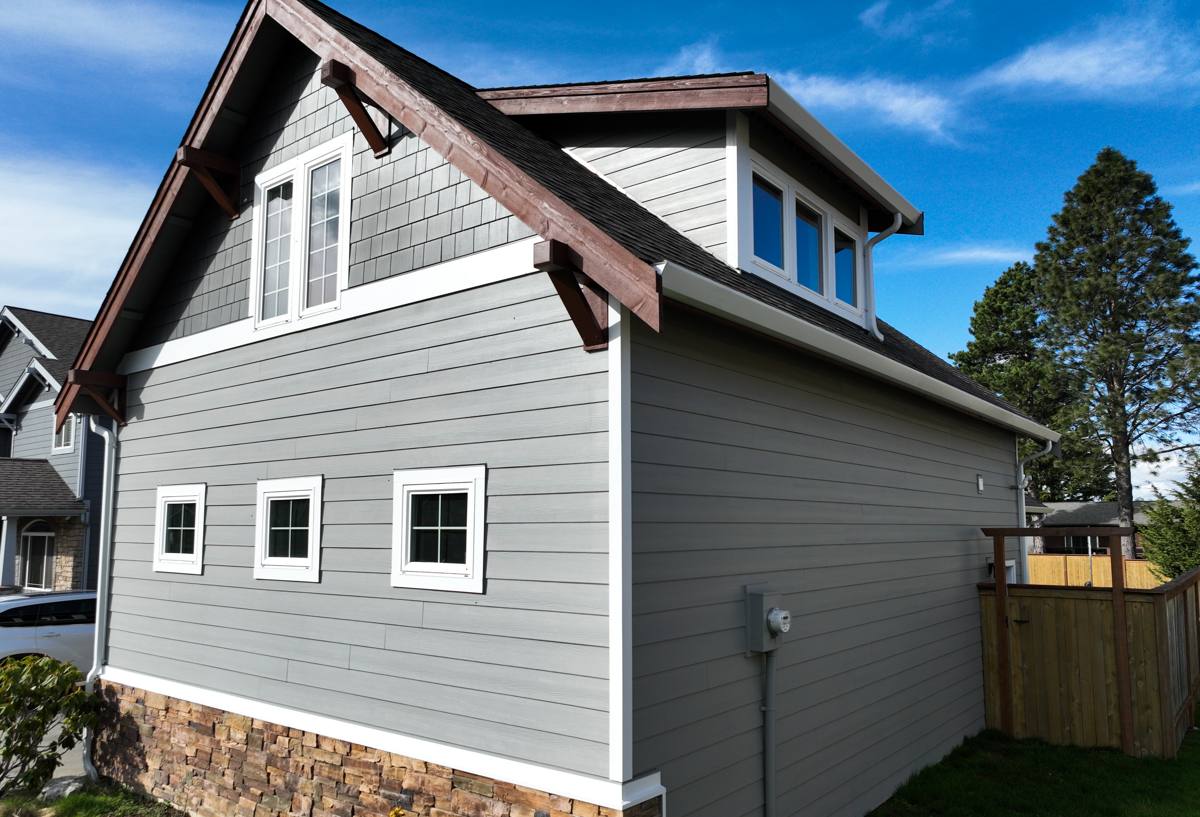
What Whatcom County Weather Actually Does to a House
Driving Rain
Bellingham doesn't get the heaviest rainfall totals in the state, but it gets a lot of wind-driven rain off the water, especially in fall and winter storms. Driving rain doesn't just fall on a wall — it gets pushed sideways into laps, seams, and butt joints. Any siding product with weak moisture resistance at the edges will start absorbing water at those joints long before the field of the panel shows a problem.
The Long Moss Season
Between the shade, the humidity, and the mild temperatures, this area effectively has a moss and algae season that runs most of the year, not just a few weeks in spring. Moss holds moisture against a wall surface. On wood-based products, that sustained dampness is exactly the condition that leads to swelling, delamination, and rot at edges and fastener points. On paint film, it's what causes early peeling and staining.
Salt Air Near the Water
Closer to Bellingham Bay, airborne salt speeds up corrosion on nails, screws, and any exposed metal trim. It also degrades some paint and coating systems faster than manufacturers' inland testing accounts for. This isn't a dealbreaker for a well-built exterior, but it does mean fastener choice and coating quality matter more here than in a drier, inland climate.
Why We Only Install James Hardie
We used to install a wider range of siding products. Over years of callbacks, tear-offs, and honest conversations with homeowners about what was failing and why, we standardized on James Hardie fiber cement and stopped installing everything else. Here's the reasoning, product by product.
Vinyl Siding
Vinyl is inexpensive and low-maintenance in the sense that it doesn't need painting, but it has real limits in this climate. It expands and contracts significantly with temperature swings, which over time opens gaps at seams and corners — exactly where driving rain wants to get in. It can also warp or become brittle, and once damaged, individual panels are difficult to color-match years later. It's a reasonable budget product in the right setting, but we don't think it's the right long-term investment for homes taking on Whatcom County's wind and rain.
LP SmartSide
LP SmartSide is an engineered wood product, and engineered wood — no matter how well treated — is still wood. Wood absorbs and releases moisture, and in a climate with this much sustained dampness and moss growth, that moisture cycling is a real long-term liability, especially at cut edges and fastener penetrations if they're not field-sealed correctly every single time. It's a capable product when installation is flawless and maintenance never lapses. We'd rather not bet a homeowner's siding investment on that.
Cemplank and Allura
Both are fiber cement competitors to Hardie, and fiber cement as a category is the right call for this region — non-combustible, dimensionally stable, and far less sensitive to moisture than wood or vinyl. Where we draw the line is the factory finish and warranty structure. We've found Hardie's ColorPlus finishing process and its transferable warranty coverage to be more consistent and better backed than the alternatives, so that's what we install.
Primed Spruce and Cedar
Natural wood siding is beautiful, and we understand the appeal, especially on homes near the trees around Lake Whatcom. But raw or primed wood requires a maintenance commitment — recoating, caulking, and inspection on a strict schedule — that most homeowners don't realize they're signing up for until the first patches of moss and paint failure show up. In a climate with this much sustained moisture, that maintenance burden is higher here than almost anywhere else in the state.
How James Hardie Handles This Climate
James Hardie fiber cement is engineered specifically to resist moisture, and the HZ5 product line in particular is formulated for the freeze-thaw and moisture cycling common in the Pacific Northwest. It won't rot, it resists pest damage, and it's non-combustible. The ColorPlus factory finish is baked on under controlled conditions rather than field-applied, which gives it more consistent coverage and better fade and moisture resistance than a coat of paint applied on-site in variable weather — a real advantage in a market where you can lose good painting weather for weeks at a time.
None of that means Hardie is maintenance-free. It still needs to be installed correctly — proper clearance from grade and roof lines, correct fastener patterns, and sealed joints where the manufacturer specifies. Installed to spec, it's a product built for exactly the conditions Bellingham and Sudden Valley homes deal with every winter.
Product Comparison at a Glance
| Product | Moisture Behavior in This Climate | Maintenance | Our Position |
|---|---|---|---|
| Vinyl | Seams can open with expansion/contraction; wind-driven rain intrusion risk | Low, but limited repair options | Not installed |
| LP SmartSide | Engineered wood; moisture-sensitive at cuts and edges | Moderate to high — sealing and inspection required | Not installed |
| Cedar / Primed Spruce | Natural wood; absorbs moisture, prone to moss and rot without upkeep | High — regular recoating and caulking | Not installed |
| Cemplank / Allura | Fiber cement; good moisture resistance | Low | Not installed (finish and warranty preference) |
| James Hardie | Fiber cement engineered for PNW moisture cycling | Low | What we install |
What a Local Crew Means for Bellingham and Sudden Valley Homeowners
A crew that works this area regularly knows which sides of a house take the worst weather, where moss builds up fastest, and how local wind patterns off Bellingham Bay push rain into an exterior. That local knowledge shapes real decisions on a job — flashing details, fastener spacing, where extra caulking or drainage attention actually matters versus where it's overkill. It also means when a homeowner has a question two years after installation, they're calling a crew that's still working in the same neighborhoods, not chasing down a company that's moved on to another region.
Our Services Beyond Siding
Siding is our specialty, but exterior problems rarely show up in isolation. A home with moss-stressed siding often has a roof due for attention, windows that have let moisture into wall cavities, or a deck that's been absorbing the same rain and shade issues. We handle:
- James Hardie fiber cement siding installation and replacement
- Roofing repair and replacement
- Window replacement, including addressing water intrusion at old window openings
- Deck construction and repair, built for wet-climate durability
Looking at the exterior as one connected system, rather than fixing one component at a time, catches problems before they become bigger repairs.
Signs Your Siding Needs a Closer Look
Homeowners in Sudden Valley and greater Bellingham should watch for a few specific warning signs, especially heading into the wet season:
- Persistent moss or algae growth that returns quickly after cleaning
- Soft spots or visible swelling, particularly near the bottom of walls or around windows
- Paint that's peeling or bubbling rather than just fading
- Gaps opening at seams, corners, or trim joints
- Visible rust streaking from fasteners or trim
- Musty smells or moisture signs on interior walls that back up to exterior siding
What Cost Factors Actually Look Like
Every home is different, but the main variables that drive siding project cost here are consistent:
| Factor | Why It Matters |
|---|---|
| Home size and wall complexity | More corners, dormers, and cutouts mean more labor and material waste |
| Existing siding removal | Tear-off adds labor, especially if there's hidden moisture damage underneath |
| Substrate repair | Rotted sheathing or framing found during tear-off needs to be addressed before new siding goes on |
| Hardie product line and finish | Plank profile, texture, and ColorPlus color selection affect material cost |
| Access and site conditions | Slopes, tree cover, and driveway access around Lake Whatcom properties can affect setup time |
We don't quote broad numbers without seeing the house — too many of these variables swing the estimate — but we're upfront about what's driving the cost during the estimate visit.
Getting Started
If you're noticing moss buildup, paint failure, or soft spots on your home's exterior, it's worth getting a professional look before another wet Whatcom County winter makes the problem worse. We'd be glad to walk your property, look at what your siding, roof, windows, or deck are dealing with, and give you a straightforward, no-pressure estimate — just fill out the form below to get started.