 Sudden Valley Siding
 Why Fairhaven's Climate Is Harder on Siding Than It Looks
Fairhaven sits close enough to Bellingham Bay that homes here deal with a combination of stresses that inland Whatcom County properties don't see nearly as often: salt-laden air moving in off the water, driving wind-driven rain during fall and winter storms, and a moss season that can stretch for most of the year in shaded, north-facing spots. None of these factors is dramatic on its own. Together, over years, they're what separates a siding job that still looks sharp at year fifteen from one that's chalking, staining, and softening at the seams by year eight.
Salt air is corrosive to exposed metal fasteners, flashing, and trim hardware, and it accelerates the breakdown of lower-grade paint films on wood and composite sidings. Add in the region's persistent damp — heavy fall rains, marine fog, and long stretches of overcast humidity — and you get an environment where anything that can absorb moisture eventually will, especially at butt joints, corners, and anywhere caulking has started to fail. Moss and algae growth is the visible symptom of all that moisture sitting on north- and west-facing walls that don't get much direct sun to dry out between storms.
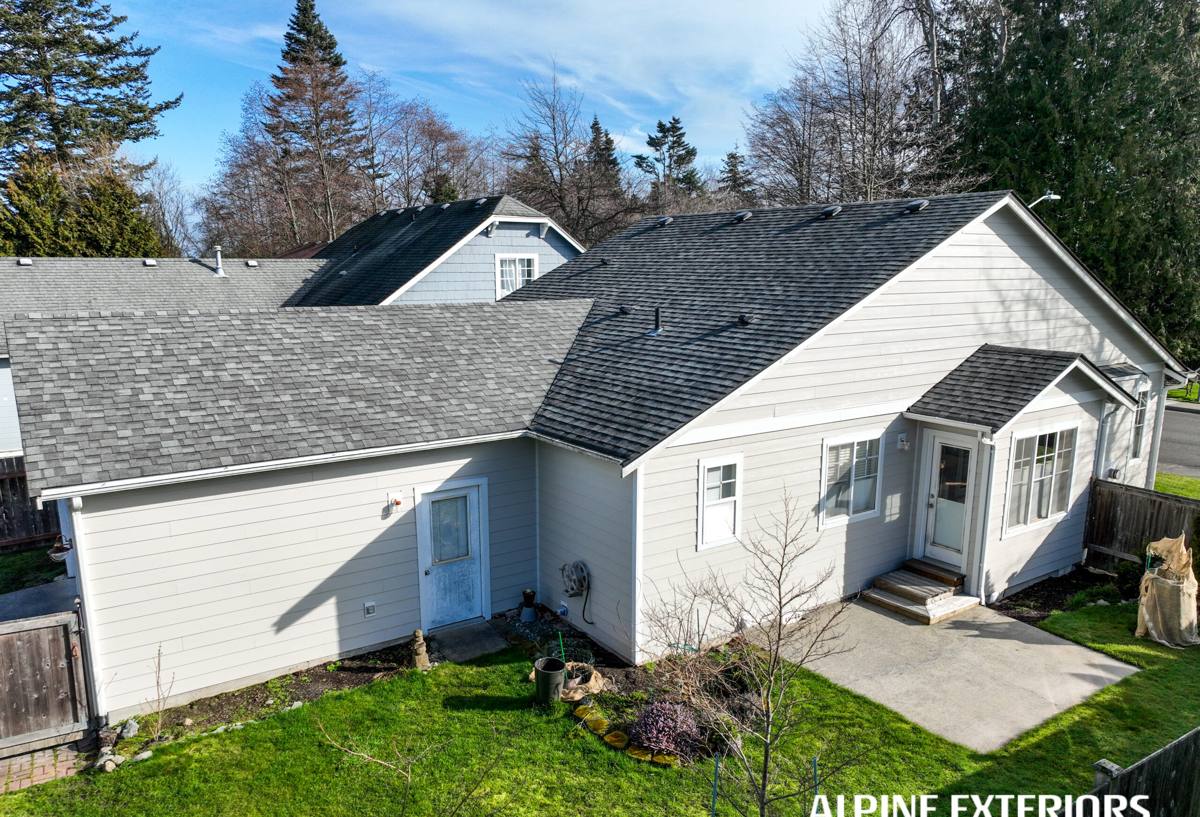
What This Actually Does to Different Siding Materials
The failure patterns we see on Fairhaven homes tend to follow a predictable pattern based on what's actually on the wall:
- Cedar and primed wood siding: absorbs moisture at end grain and joints, which shows up as cupping, checking, and paint failure well ahead of the manufacturer's expected repaint cycle.
- Vinyl siding: doesn't rot, but salt air and UV combine to fade and chalk the surface faster than in drier inland areas, and panels can warp where sun exposure is uneven.
- Engineered wood composites (like LP SmartSide): perform reasonably well when installed and maintained correctly, but any breach in the factory coating at a cut edge or fastener hole becomes a moisture entry point in this climate faster than in a drier one.
- Uncoated or poorly finished fiber cement: without a durable factory finish, fiber cement can still absorb surface moisture and show streaking or efflorescence in a consistently damp environment.
This is exactly why we standardized on James Hardie fiber cement with the factory-applied ColorPlus finish rather than field-painted or lower-grade alternatives. Fiber cement itself is non-combustible and dimensionally stable, but the finish system on top of it is what determines how it holds up against years of salt air and rain.
Why We Install Only James Hardie Fiber Cement
We get asked fairly often why we don't offer vinyl, LP SmartSide, or unfinished wood siding options. It's not that these products don't have a place in the market — it's that for a marine-influenced climate like Fairhaven's, we've made a professional decision to standardize on one system we trust to perform consistently, rather than juggling multiple product lines with different moisture tolerances and warranty structures.
What James Hardie Gets Right for This Climate
- Non-combustible fiber cement core that doesn't rot, warp, or attract pests the way wood-based products can.
- ColorPlus factory finish — baked on under controlled conditions, which holds color and resists fading and chalking far better than field-applied paint exposed to salt air during cure.
- HZ5 and HZ10 product engineering — Hardie's climate-specific formulations are built to handle moisture-heavy, freeze-thaw-adjacent regions like the Pacific Northwest.
- A strong, transferable limited warranty on both the substrate and the finish, which matters more in a climate that stresses siding harder than average.
We're upfront that Hardie siding costs more upfront than vinyl or basic composite panels. The trade-off is a product system engineered specifically for exposure conditions like Fairhaven's, backed by a manufacturer warranty and installed by a crew that installs nothing else — which means our detailing, flashing, and fastening practices are built around getting the most out of one product, not spread thin across five.
How Correct Installation Protects Against Moss and Moisture
The material only performs as well as the installation underneath it. In a climate with this much sustained moisture, a handful of installation details matter more here than they would in a drier region:
Details We Watch Closely on Fairhaven Jobs
- Rainscreen or drainage gap: a ventilated air space behind the siding lets bulk water drain and the wall assembly dry, instead of trapping moisture against the sheathing.
- Flashing at every horizontal transition: window heads, roof-to-wall intersections, and deck ledgers are where driving rain finds its way in if flashing is skipped or undersized.
- Proper fastener placement and caulking at joints: following Hardie's fastening schedule and using compatible sealants keeps water out of butt joints, which is where most moisture-related siding failures start.
- Clearance from grade and hardscape: keeping the bottom edge of the siding at the manufacturer-specified height above soil, decking, or paving reduces splash-back moisture and gives moss less to hold onto.
None of this is exotic — it's standard best practice — but it's also the kind of detail that gets rushed or skipped on lower-bid jobs, and it's exactly where problems show up first in a wet, salt-air environment like this one.
Moss, Algae, and Long-Term Maintenance in Fairhaven
Even with the right siding and correct installation, moss and algae growth is something homeowners in shaded coastal-influenced neighborhoods should expect to manage, not eliminate entirely. A few practical habits go a long way:
- Keep gutters clear so overflow doesn't run down the wall face and feed moss growth at the top course.
- Trim back vegetation and tree canopy that keeps siding shaded and damp longer than necessary.
- Rinse north- and west-facing walls periodically with a garden hose (not a pressure washer aimed directly at joints) to knock down surface growth before it establishes.
- Inspect caulking at trim and joints annually, since UV and salt exposure break down sealants faster here than inland.
Hardie's factory finish resists moss and algae staining better than bare wood or field-painted surfaces, but no exterior material is immune to a climate that stays damp this much of the year. Regular light maintenance is what keeps a well-installed Hardie exterior looking clean for decades rather than just years.
Cost Factors for Fairhaven Homes
Every property is different, but a few factors consistently affect the scope and cost of a siding project in this area:
| Factor | Why It Matters Here |
|---|---|
| Existing wall condition | Homes with long-term moisture intrusion may need sheathing repair before new siding goes on |
| Exposure orientation | North/west-facing walls with heavy shade often need extra attention to drainage detailing |
| Trim and detail complexity | More corners, window trim, and transitions mean more flashing and labor time |
| Access and site conditions | Sloped lots and limited access near the water can affect staging and scaffolding needs |
| Siding profile and color | Lap width and ColorPlus color selection affect material cost but not long-term durability |
Roofing, Windows, and Decks: The Rest of the Building Envelope
Siding doesn't work in isolation. On most homes we work on in this area, the roof, windows, and any attached decks share the same exposure to salt air and driving rain, and problems in one system often show up as damage in another — a failing window flashing can rot the wall cavity behind good siding, and a deck ledger without proper flashing can channel water directly into the wall assembly. Because we handle siding, roofing, windows, and decks, we look at the whole exterior envelope on a Fairhaven property rather than treating siding as an isolated cosmetic job. That matters most at the intersections: roof-to-wall step flashing, window head flashing, and deck ledger connections are consistently where we find the moisture problems that started years before anyone noticed a stain on the siding.
Why a Local Crew Matters Here
A crew that works throughout Sudden Valley and the surrounding Whatcom County communities knows which walls on a given lot take the worst of the winter storms, how much moss pressure to expect on a shaded north elevation, and how the marine layer affects cure times and scheduling. That local pattern recognition shapes real decisions on the job — where to add extra flashing attention, which elevations need a closer look at the drainage plane, and how to sequence work around the wetter months. It's a different level of judgment than a crew working from a generic install manual with no sense of how this specific stretch of coastline behaves.
Get a Free, No-Pressure Estimate
If you're noticing moss buildup, fading, soft spots, or failing caulk on your Fairhaven home's exterior, we're happy to take a look and give you an honest read on what's going on and what it would take to fix it right. There's no obligation — just a straightforward assessment from a crew that works this climate every day. Fill out the form below to schedule a free estimate.