 Sudden Valley Siding
 What Columbia Homes Are Up Against
Homes in the Columbia area, tucked into the broader Sudden Valley and Whatcom County service region, deal with a specific combination of exterior stressors that homeowners further inland rarely have to think about. Marine air moving in off the water carries salt that settles on exterior surfaces, tree cover keeps siding shaded and damp longer after every storm, and the region's long, wet stretch of fall-through-spring weather gives moss and mildew months at a time to take hold. None of this is dramatic on its own. It's the accumulation that gets homeowners — paint that fades unevenly, trim that stays soft to the touch, and siding seams that start letting water in years before anyone notices a problem.
Driving rain is the other half of the equation. Whatcom County doesn't just get a lot of rain, it gets rain that comes in sideways during winter storms, which means siding has to handle water pressure against the wall face, not just water running down it. Materials and installation details that work fine in a drier climate start showing their weaknesses here within a handful of seasons.
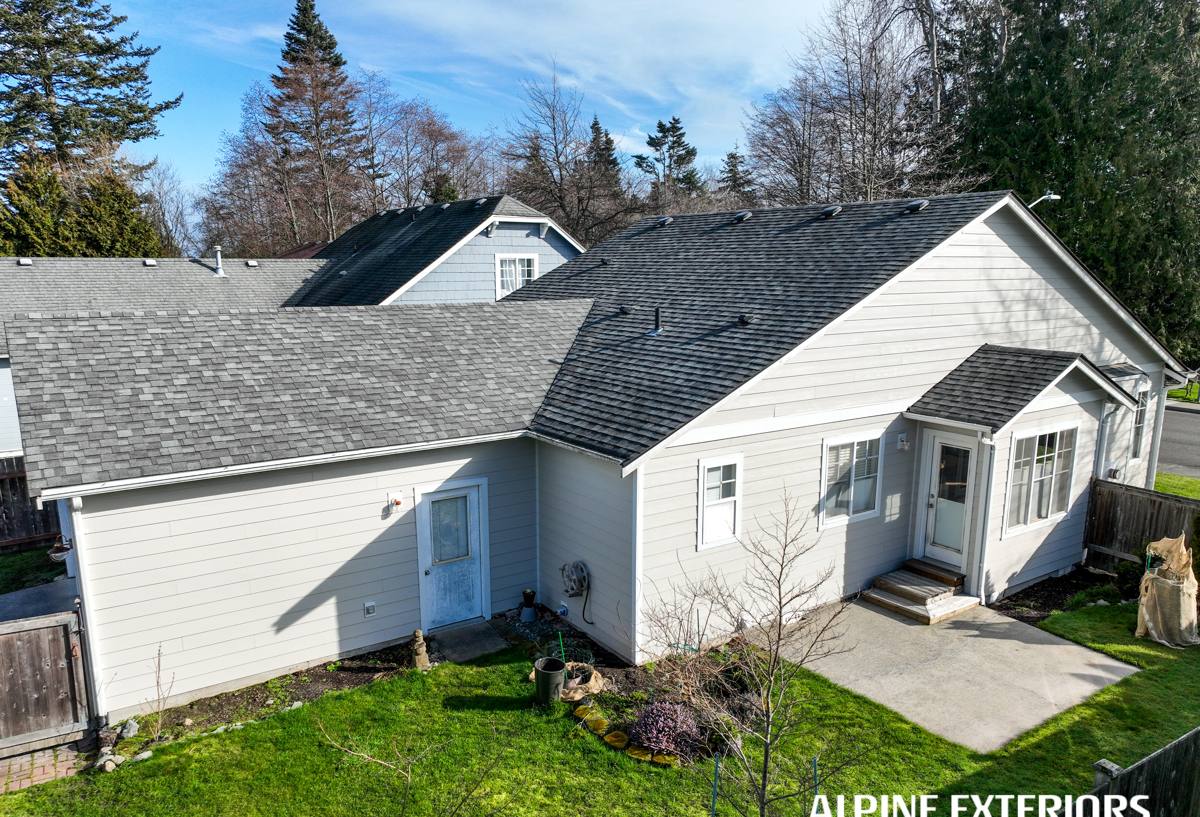
Why Siding Material Choice Matters More in This Climate
Not all siding materials handle salt air, sustained moisture, and moss exposure the same way. Some are more forgiving of installation shortcuts than others; some hold paint better in damp, shaded conditions; some are simply more attractive to moss and algae because of their surface texture. Here's how the common options stack up against the conditions Columbia homes actually face.
| Material | Moisture Behavior | Moss/Algae Resistance | Salt Air Durability |
|---|---|---|---|
| Vinyl | Doesn't absorb water, but expands/contracts with temperature swings, opening gaps at seams over time | Smooth surface resists some growth, but grime and salt film build up in the profile grooves | Can become brittle and discolored with prolonged UV and salt exposure |
| LP SmartSide (engineered wood) | Wood-based core is vulnerable if the factory seal is compromised at cuts or fasteners | More susceptible to surface mildew in shaded, damp spots | Requires diligent field-sealing of every cut edge to hold up |
| Cedar | Naturally moisture-tolerant but needs ongoing sealing/staining to stay that way | Prone to moss and algae in shaded, wet conditions without regular maintenance | Handles salt reasonably well but demands the most upkeep of any option here |
| James Hardie fiber cement | Cement-based composition doesn't swell, rot, or delaminate from water exposure | Dense surface and factory finish resist moss/algae adhesion better than wood-based products | Engineered HZ product lines are formulated specifically for high-moisture, coastal-influenced climates |
This is exactly why our company made a decision that some homeowners find surprising when they first call us: we only install James Hardie fiber cement siding. We don't install vinyl, LP SmartSide, Cemplank, Allura, primed spruce, or cedar. That's not a marketing position — it's a standard we hold because we've seen which products actually perform, year after year, on homes exposed to what Columbia deals with.
What We're Not Willing to Compromise On
Every one of those alternative products has legitimate strengths, and we're not going to pretend otherwise. Vinyl is inexpensive and low-maintenance in mild climates. Engineered wood siding looks good and installs quickly. Cedar has a natural appearance a lot of homeowners love. But in a climate with sustained rain, shaded moisture retention, and salt-laden air, the trade-offs on all three show up faster and cost more to fix than the upfront savings are worth. We'd rather turn down a job than install something we don't think will hold up on a Columbia home.
Why We Standardized on James Hardie
James Hardie fiber cement is non-combustible, which matters for wildfire-adjacent insurance considerations even in a wet climate, and it's dimensionally stable — it doesn't expand and contract the way wood or vinyl does with our seasonal temperature and humidity swings. The ColorPlus factory finish is baked on under controlled conditions, which gives it a more even, longer-lasting color than field-applied paint, and it comes with a real, transferable warranty that follows the house if it's sold.
Hardie's HZ5 product line in particular is engineered for climates with high moisture exposure, which describes this part of Whatcom County well. It's not a one-size-fits-all product — the HZ system exists because different regions of the country put different stress on siding, and this region's stress is moisture, not just heat or cold.
More Than Siding: The Full Exterior Envelope
Siding doesn't work in isolation. Water that gets past a roof, a window flashing detail, or an undersized deck ledger board will find its way behind even the best siding installation. That's why we handle roofing, windows, and decks alongside siding rather than treating them as separate trades.
Roofing
A roof that's shedding water properly, with intact flashing at every valley, chimney, and wall intersection, is the first line of defense for everything below it. In a climate that gets sustained rain for months at a time, roof-to-wall transitions are one of the most common places we find hidden water damage during siding tear-off.
Windows
Window flashing and sealant details matter as much as the window itself. We integrate window replacement with siding work whenever possible so the flashing, house wrap, and siding all tie together correctly instead of being patched around each other by different contractors at different times.
Decks
Decks take the same driving rain and moss exposure as siding, plus standing water and foot traffic. Ledger board attachment and proper flashing where a deck meets the house are frequent failure points we address when we're already working on a home's exterior.
What a Correct Hardie Installation Involves
Fiber cement siding is only as good as the installation behind it. Hardie publishes specific installation requirements around clearances, fastening patterns, and joint treatment, and skipping them is the single biggest reason any siding product underperforms.
- Proper house wrap or weather-resistant barrier installed and lapped correctly before siding goes on
- Minimum clearance maintained between siding and grade, decks, roof lines, and other horizontal surfaces
- Correct fastener type, spacing, and depth per Hardie's published specifications
- Factory-cut edges used wherever possible; any field cuts properly sealed
- Butt joints and trim details flashed to shed water rather than trap it
- Caulking limited to where Hardie specifies it — over-caulking can trap moisture instead of releasing it
These aren't optional refinements. A Hardie installation that skips clearance requirements or fastener specs can develop moisture problems just as easily as any other product, which is why the crew doing the work matters as much as the material itself.
Cost Factors Homeowners Should Understand
Every home in Columbia is different, so we don't quote sight-unseen, but the same factors drive cost on nearly every project we look at.
| Factor | Why It Affects Cost |
|---|---|
| Existing siding removal | Tear-off, disposal, and any sheathing repair found underneath add labor before new siding even starts |
| Home size and complexity | More corners, gables, and trim details mean more cutting, fitting, and flashing work |
| Moisture damage discovered mid-project | Rotten sheathing or framing found once old siding comes off has to be repaired before new siding goes up |
| Color and trim selections | ColorPlus factory finishes vary by product line, and trim/accent choices affect material counts |
| Scope beyond siding | Bundling roofing, window, or deck work into the same project changes scheduling and total cost, sometimes favorably |
Why a Local Crew Matters in This Climate
A crew that works Whatcom County exteriors regularly knows what to check for before a job starts and what to expect once the old siding comes off. That means recognizing moss staining patterns that point to trapped moisture, knowing which wall orientations in this area take the worst of the driving rain, and understanding how salt-influenced air affects fastener and flashing choices over the long run. It also means we're still here in five or ten years if a warranty question comes up — we're not a crew that came through from out of the area for one season.
A Straightforward Process
Our process for Columbia homes starts with an on-site inspection, not a phone estimate. We look at the current siding condition, check for existing moisture damage, and assess the roof, window, and deck details that interact with the siding. From there we walk homeowners through Hardie product line and color options, provide a written scope and price, and schedule the work around the wetter months when possible so tear-off doesn't leave a home exposed longer than necessary.
If you're weighing a siding project for a Columbia home, or wondering whether your current siding is holding up the way it should, we're glad to take a look and give you a straight answer. Reach out for a free, no-pressure estimate — there's a form below whenever you're ready.