 Sudden Valley Siding
 What Board and Batten Actually Means
Board and batten is one of the oldest siding patterns in American building, and it's having a real moment in the Pacific Northwest right now. The look is simple: wide vertical panels (the "boards") installed with narrower strips (the "battens") covering the seams between them. It reads as clean, modern, and a little bit farmhouse all at once, which is why we get more requests for it every year on new builds and re-sides around Whatcom County.
What most homeowners don't realize going in is that "board and batten" describes a pattern, not a material. You can build this look out of real wood, engineered wood, vinyl, or fiber cement, and the material you pick determines almost everything about how the siding performs once it's actually up against Sudden Valley weather — the salt air off the lake, the driving rain that comes sideways in a fall storm, and the long stretch of gray, damp months that keep moss and algae growing on anything that holds moisture.
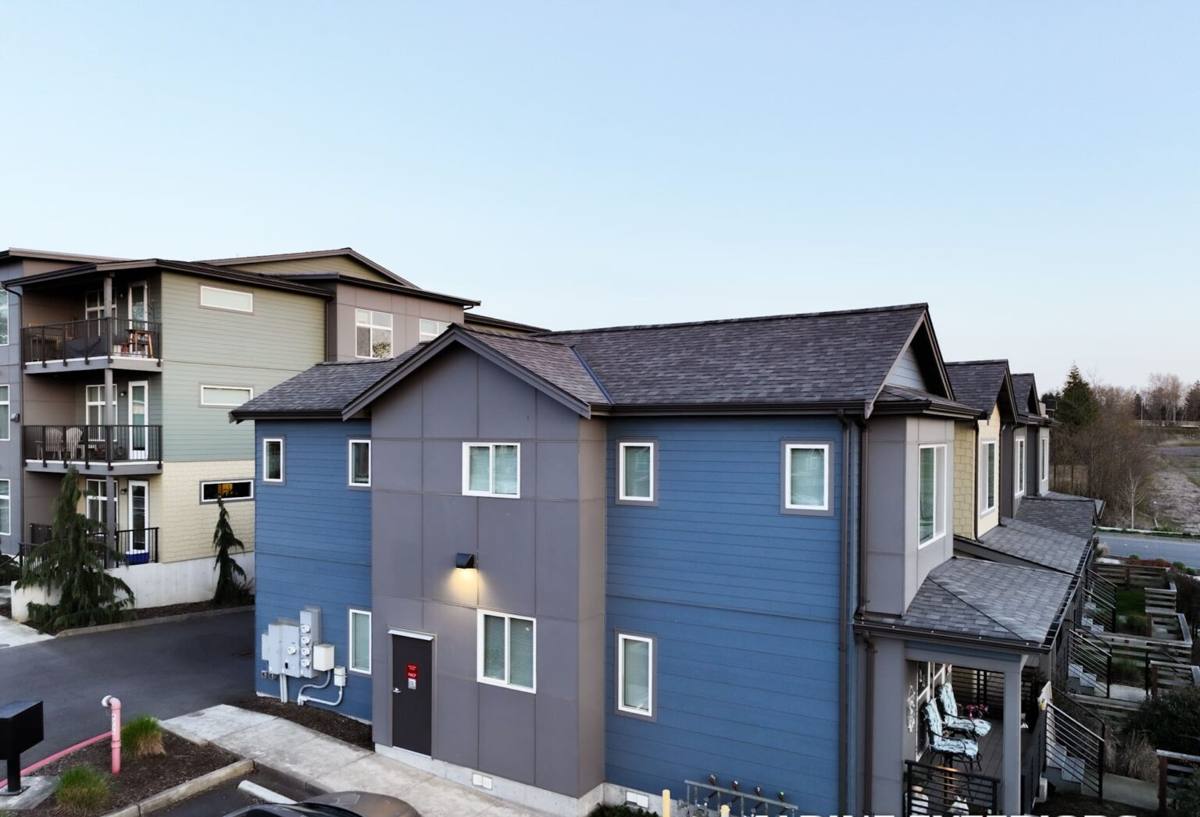
James Hardie's Board and Batten Systems
We install James Hardie exclusively, and for this style there are two ways to build it correctly with their product line:
HardiePanel Vertical Siding with Battens
This is the more common approach: large fiber cement panels installed vertically, with HardieTrim boards fastened over the seams to create the batten lines. HardiePanel comes in several textures — smooth, stucco, and select cedarmill — so you can dial in how much grain texture shows through the paint.
Individual HardiePlank Boards, Vertically Oriented
Less common but used for a more traditional, narrower board look, especially on accent gables or dormers where a bigger panel would look out of scale.
Either way, the batten strips themselves are HardieTrim — the same fiber cement product used for corner boards and window trim — not a softwood substitute. That matters more than it sounds like, and we'll get to why in the installation section below.
True Board and Batten vs. Batten-Look Products
Some manufacturers sell a single panel pre-scored to look like board and batten without actual raised battens. It's a legitimate lower-cost option and we won't tell you it looks bad from the street. But it's a flat panel with grooves, not a dimensional pattern, and it reads differently up close — no shadow line, no real depth. If the goal is the classic board and batten shadow and texture, you want actual boards and battens, not a printed pattern.
Why We Use Fiber Cement for This Look Specifically
Board and batten has more seams, more trim, and more butt joints per square foot than horizontal lap siding. Every one of those joints is a place water can find its way behind the siding if the material moves, shrinks, or the joint isn't detailed correctly. In a climate like ours — Sudden Valley sits in a corridor that gets sustained wet seasons, plus lake-effect humidity and salt air that accelerates corrosion on fasteners and finishes — that seam density is exactly where cheaper materials show their weaknesses first.
Fiber cement doesn't expand and contract with moisture and temperature the way wood or wood-composite products do, so those seams stay tighter over the life of the siding. It's also non-combustible, which matters increasingly for insurance underwriting in Washington regardless of proximity to wildfire zones. And because James Hardie engineers regional product lines (their HZ5 line is built for cold, wet climates like ours), the panels are formulated for exactly the freeze-thaw and moisture cycling we get here, not a one-size-fits-all national spec.
Color and Finish Choices
This is where board and batten either looks sharp for twenty years or looks tired in five, and it comes down to the finish, not the pattern.
ColorPlus Factory Finish
James Hardie's ColorPlus is baked on at the factory in a controlled environment, with a finish warranty separate from the product warranty. On a board and batten install, this matters more than on lap siding because you've got exposed cut edges at every batten and panel joint — Hardie's touch-up system is formulated to match ColorPlus exactly, so those cut edges don't weather differently than the face of the panel.
Field-Painted Primed Panels
Still an option, and sometimes the right call for a very specific custom color. But field paint on a house with this many seams and edges means more surface area for the paint job to eventually fail unevenly, and repainting a full board and batten elevation is more labor-intensive than repainting lap siding because of all the trim.
Popular board and batten colors we're seeing requested most in this area run toward deep charcoals, warm grays, and matte blacks paired with lighter trim — colors that read well against evergreen backdrops and don't show water spotting the way pure white does in a wet climate.
Installation Details That Actually Determine How It Ages
Board and batten is less forgiving of installation shortcuts than standard lap siding. A few specifics we hold to on every job:
- Fastener placement: Battens are face-nailed or blind-nailed per Hardie's engineering specs, with fastener spacing tighter near panel edges where wind uplift is highest.
- Rainscreen gap: Vertical siding benefits from a drainage gap behind the panel so any moisture that does get past the face has somewhere to go besides your sheathing. We install this as standard, not an upgrade.
- Butt joint flashing: Every horizontal panel-to-panel joint gets proper flashing or a Hardie-approved joint treatment — caulk alone is not a joint detail, it's a maintenance item waiting to fail.
- Batten width and reveal consistency: Inconsistent batten spacing is the single most common sign of a rushed board and batten job, and it's purely a workmanship issue, not a material one.
- Correct clearance at grade, decks, and roof lines: Fiber cement needs a minimum clearance from grade, roofing, and other flatwork to avoid wicking moisture — an easy detail to skip and a common source of callbacks industry-wide.
None of this is exotic. It's the difference between following Hardie's published installation specs and not, and it's the reason we say installation quality matters as much as the product choice itself.
Board and Batten Material Comparison
| Material | Seam behavior over time | Moss/algae resistance | Fire rating | Typical repaint cycle |
|---|---|---|---|---|
| James Hardie fiber cement | Stable, minimal movement | Good, especially with ColorPlus | Non-combustible | ColorPlus: 15+ years; field paint: 7-10 |
| Cedar board and batten | Shrinks/swells seasonally, seams open | Prone to moss/mildew without upkeep | Combustible | 3-7 years |
| Vinyl vertical panel | Expands/contracts, can bow | Moderate, can trap moisture behind | Combustible, can deform near heat | Not paintable (color is baked/limited) |
| Engineered wood (LP-type) | More stable than cedar, still wood-based | Moderate; edge treatment critical | Combustible | 7-10 years |
We don't install the vinyl, engineered wood, or cedar options listed above — that's a standard we set for our own work, not a claim that every home with those materials is in trouble. Plenty of well-maintained cedar and engineered wood siding jobs hold up fine with regular upkeep. Our point is narrower: for the seam-heavy geometry of board and batten in this specific climate, we think fiber cement with a factory finish is the better long-term bet, and it's the only thing we'll put our name behind.
Where Board and Batten Works Best
You don't have to side an entire house in board and batten to get the look. Common approaches we build for Sudden Valley homes:
- Full elevation: Modern farmhouse and craftsman builds, especially on street-facing walls
- Gable accents: Board and batten in the gable end with lap siding below — a strong way to add texture without a full re-side budget
- Dormers and bump-outs: Small vertical sections that break up a large horizontal elevation
- Garage and shop faces: A common, cost-effective way to differentiate a garage from the main house
Mixing board and batten with horizontal HardiePlank on the same home is one of the more popular requests we get, and it's a straightforward job when both products are Hardie — the trim details and fastening specs are designed to work together.
Maintenance and What to Expect Long-Term
Fiber cement board and batten with a ColorPlus finish is genuinely low-maintenance, but "low" isn't "zero." An annual rinse-down helps in this region given how much moss and algae growth we see on north-facing and shaded walls through the wet months. Caulking at trim joints should get a visual check every couple of years — not because Hardie's product fails, but because caulk is caulk and it's the first thing to age regardless of what's behind it. Keep gutters and downspouts directed away from the siding face, and keep vegetation trimmed back so walls get airflow and sun exposure to dry out between storms.
Cost Factors to Understand Before You Budget
| Factor | Why it moves the price |
|---|---|
| Batten density | More battens per elevation means more trim material and more labor hours |
| Panel vs. board approach | Larger panels install faster than individual narrow boards |
| Full elevation vs. accent | Accent applications cost less but require careful transition detailing to lap siding |
| ColorPlus vs. field paint | ColorPlus costs more upfront, less over a 15-20 year horizon |
| Tear-off vs. new construction | Removal of existing siding and any needed sheathing repair adds labor |
We don't publish blanket per-square-foot pricing because these variables swing the number too much to be useful — a gable accent and a full-elevation board and batten re-side are different projects entirely.
If you're weighing board and batten for a Sudden Valley home, whether it's a full re-side or an accent on one or two elevations, we're happy to walk the property, talk through where it makes sense architecturally, and put together a straightforward, no-pressure estimate.