 Sudden Valley Siding
 Why Bellingham and Sudden Valley Homes Need Siding Built for This Climate
Homes around Bellingham and Sudden Valley sit in one of the more demanding climates on the West Coast for exterior materials. You've got moisture off Bellingham Bay and Lake Whatcom pushing salt-laden air into siding seams, long stretches of driving rain that come in sideways off Puget Sound storms, and a moss and mildew season that can run eight or nine months out of the year in shaded, tree-lined lots. Whatcom County doesn't get the extreme heat that breaks down siding in other parts of the country, but it makes up for it with sustained, low-grade moisture exposure that never really lets up. That's the thing most homeowners underestimate: it's not one big event that ruins siding here, it's years of steady dampness finding every weak point in the material and the installation.
We install James Hardie fiber cement siding exclusively, and we don't say that as a sales pitch — it's the reason this page exists. Wood-based and foam-backed composite sidings that perform fine in drier climates tend to struggle here, and we'd rather explain why than sell you something we don't trust on our own roofs.
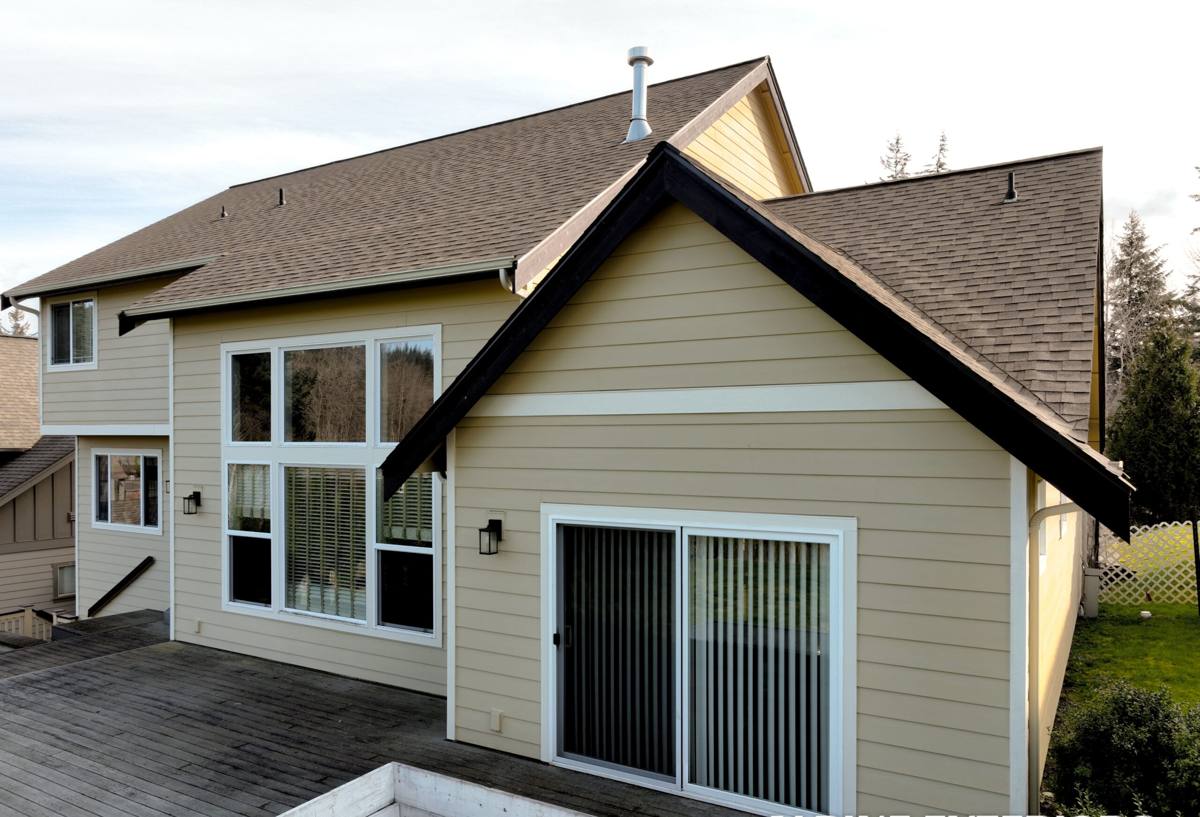
What Actually Happens to Siding in This Climate Over Time
If you've lived in the Bellingham or Sudden Valley area for more than a few years, you've probably already seen it: siding that looks fine from the street but is soft or swollen at the bottom courses, green-black streaking on the north and shaded sides of a house, caulk lines that have pulled away and let water track behind the panels. None of that is unusual for this region — it's what happens when a material with any wood content sits in near-constant moisture.
The three things doing the damage
- Salt air: Even homes several miles inland get some exposure carried on the wind off the Sound and the Bay. Salt accelerates corrosion on fasteners and trim and speeds up the breakdown of lower-grade coatings.
- Driving rain: Wind-driven rain doesn't just wet the surface — it gets pushed into laps, seams, and butt joints if the siding and flashing details aren't installed correctly. Once water gets behind siding, it doesn't dry out quickly in our climate.
- Moss and mildew season: Shaded lots near trees and the lake hold moisture at the siding surface for long stretches. Organic growth isn't just cosmetic — it holds water against the material, which matters a lot more with wood-based products than with fiber cement.
Why We Standardized on James Hardie for This Area
James Hardie fiber cement is made from cement, sand, and cellulose fiber — there's no wood substrate to swell, rot, or feed organic growth. It's non-combustible, which matters given how many Whatcom County homes back up to trees and brush. And Hardie engineers specific product lines for different climate zones; the HZ5 line is built for regions like ours with sustained moisture exposure, rather than a one-size-fits-all product.
The factory-applied ColorPlus finish is also a big part of why we trust it here. It's baked on in a controlled environment rather than field-painted, which means better adhesion and a coating that's engineered to resist fading and moisture intrusion at the surface — the exact failure point we see on lower-grade siding around Bellingham after a few wet seasons.
| Climate Factor | What It Does to Weak Siding | How Hardie's System Addresses It |
|---|---|---|
| Salt air | Corrodes fasteners, degrades field-applied coatings faster | Factory-cured ColorPlus finish, compatible stainless/coated fastener specs |
| Driving rain | Wicks into seams and butt joints on wood-based products | Fiber cement doesn't swell or wick like wood; correct lap and flashing details keep water out |
| Moss/mildew season | Holds moisture against the surface, feeds rot on organic substrates | Non-organic substrate won't feed fungal growth; surface can be gently cleaned without damaging the material |
| General PNW dampness | Slow degradation, softening, delamination over years | HZ5 product formulation engineered for wet-climate performance |
What a Correct James Hardie Installation Involves Here
The material is only half of the equation. A lot of the siding failures we get called out to inspect around Bellingham weren't Hardie products at all — but of the ones that were, nearly all of them trace back to installation shortcuts, not the material itself. In this climate, the details matter more than in drier regions because there's less margin for error before water finds a way in.
What we check and do on every job
- Correct weather-resistive barrier and rainscreen or drainage plane behind the siding, so any moisture that does get past the cladding has somewhere to go
- Proper flashing at every window, door, and roofline intersection — the most common leak points on any home in this climate
- Manufacturer-specified fastener type, placement, and spacing (this affects both wind performance and long-term corrosion resistance)
- Correct panel gaps and caulking at butt joints, sized for the material's expansion and contraction
- Minimum clearance from grade, decks, and roof lines so siding isn't sitting in standing water or snowmelt runoff
- Field-cut edges properly sealed or primed per Hardie's installation spec
Skipping any one of these doesn't usually show up as a problem in year one. It shows up in year five or six, as soft spots, staining, or trim rot — right around when a homeowner has stopped thinking about their siding at all.
Our Process for Bellingham and Sudden Valley Jobs
1. On-site assessment
We look at your home's actual exposure — how much shade it gets, which walls take the worst of the wind-driven rain, whether there's existing moisture damage behind the current siding. Sudden Valley lots near the lake and tree line often need different flashing and drainage attention than a more open Bellingham street.
2. Tear-off and substrate check
We don't just cover over what's there. Old siding comes off so we can check the sheathing and framing underneath for existing moisture damage — this is often where we find problems the homeowner didn't know about.
3. Weather barrier and drainage plane
This step is where a lot of budget installs cut corners, and it's the step that matters most in a climate like ours. We install a proper drainage plane so the wall assembly can dry out even if some moisture does get behind the cladding.
4. Hardie panel or lap installation to spec
Installed per James Hardie's published fastening, clearance, and joint requirements — the requirements that also keep the manufacturer's warranty valid.
5. Trim, caulking, and final detailing
Every penetration, corner, and joint gets sealed correctly the first time, because re-caulking a callback six months later isn't how we'd rather spend anyone's time, including ours.
Why Hiring a Crew That Already Works This Area Matters
Siding installation isn't regionally identical. A crew used to installing in a dry inland climate will often build a wall assembly that's technically correct on paper but doesn't account for how much sustained moisture Whatcom County throws at a house. Knowing which walls in Sudden Valley take the worst wind-driven rain, how much shade a lot near the lake really gets across the seasons, and how salt exposure plays out this far into the bay isn't something you learn from a manual — it's something you learn from doing the work here, season after season.
We also know what we're looking for when we tear off old siding on a Bellingham-area home: the specific rot and staining patterns that show up on north-facing walls, the trim details that fail first in this climate, the fastener corrosion patterns that come with the salt air. That local pattern recognition is part of what you're paying for, not just the labor.
What This Kind of Job Typically Involves Cost-Wise
Every home is different, and we won't quote a number without seeing the house, but a few honest cost factors are worth knowing going in:
| Factor | Why It Affects Cost |
|---|---|
| Existing damage found at tear-off | Rotted sheathing or framing needs repair before new siding goes on — this is common on older homes in wet climates and can't always be predicted before demo |
| Home size and wall complexity | More corners, dormers, and roof intersections mean more flashing detail and labor time |
| Panel vs. lap siding style | Different Hardie product lines and profiles carry different material and install costs |
| Trim and accessory scope | Full trim replacement adds cost but avoids mismatched old trim failing next to new siding |
| Access and site conditions | Steep lots, tree cover, or tight setbacks common in Sudden Valley can add labor time |
Signs Your Current Siding May Already Be Failing
- Soft or spongy spots when you press on lower wall sections, especially near grade
- Persistent green or black staining that comes back quickly after cleaning
- Visible gaps or separation at butt joints and corners
- Bubbling or peeling paint that returns within a year or two of repainting
- Musty smell or visible staining on interior walls that back up to exterior siding
- Warped or wavy panels, particularly on shaded or north-facing walls
If you're seeing more than one of these, it's worth having someone take a real look before it turns into a sheathing or framing repair on top of a siding job.
If you're in Bellingham or Sudden Valley and want a straight answer about what your home's siding actually needs, we're happy to come take a look. The estimate is free, there's no pressure, and we'll tell you honestly what we see — use the form below to get started.