 Sudden Valley Siding
 Exterior Contractors Serving Happy Valley
Happy Valley sits in the rolling, tree-covered terrain around Sudden Valley in Whatcom County, and homes here live under a different set of pressures than a house in a dry, open subdivision. Heavy tree canopy, close proximity to Lake Whatcom, and the marine-influenced weather that moves through the county all combine to create conditions that are hard on exterior surfaces. We work this area regularly, and we've built our approach around what actually happens to siding, roofs, windows, and decks here over time rather than what happens to them in a showroom.
Being a local crew matters in a neighborhood like this. We know that a north-facing wall shaded by fir and cedar trees is going to hold moisture longer than a wall that gets afternoon sun. We know that gutters here fill with needles and leaf litter faster than in more open parts of the county, and that a clogged gutter next to fiber cement trim is a very different problem than a clogged gutter next to vinyl. That kind of site-specific knowledge shapes how we install, flash, and finish every job.
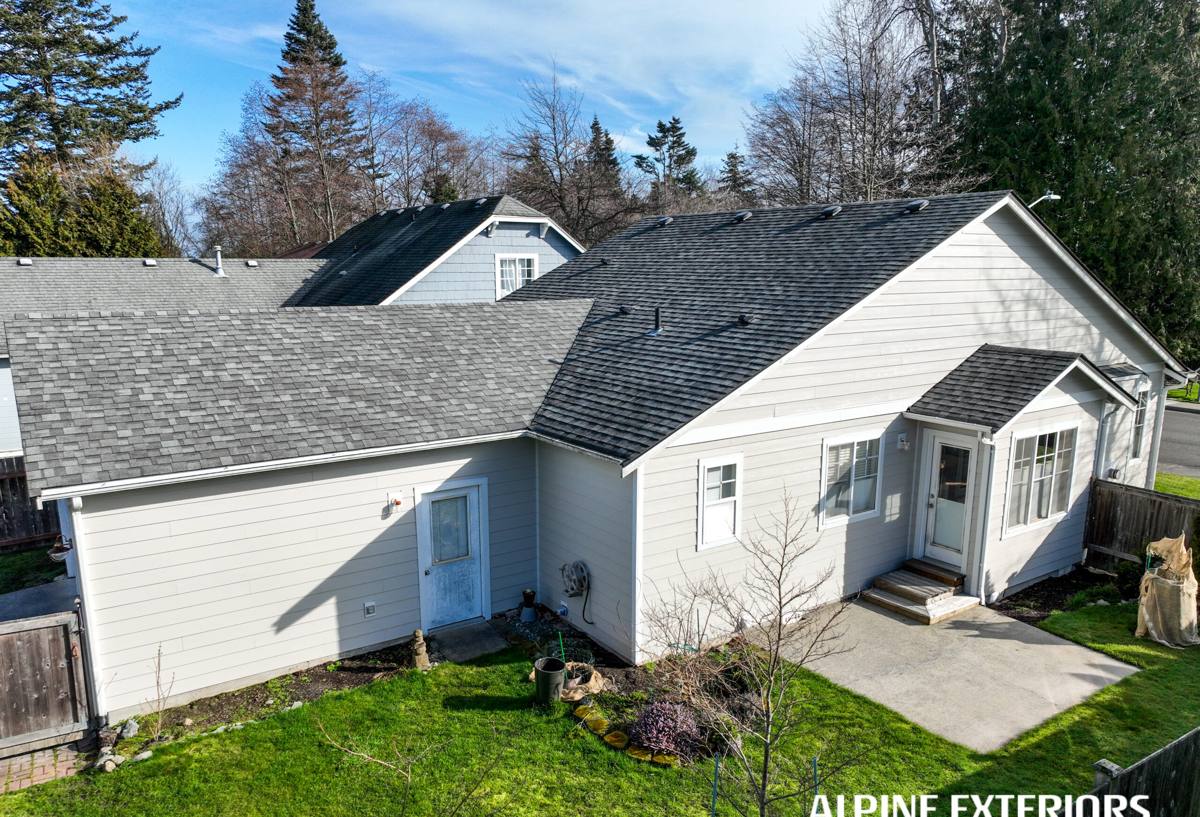
What Whatcom County Weather Does to a House
Three things define the exterior climate around Sudden Valley and Happy Valley: persistent moisture, driving rain that isn't always vertical, and a long moss and algae season that runs for most of the year in shaded spots.
Driving Rain and Wind-Driven Moisture
Storms coming through this part of Washington rarely deliver rain straight down. Wind pushes it sideways into wall assemblies, around window and door openings, and up under poorly lapped siding courses. Over years, that wind-driven rain finds every weak seam, every under-caulked joint, and every place where flashing was skipped to save time. The result isn't usually a dramatic leak — it's slow water intrusion behind the cladding that rots sheathing and framing long before anyone notices a stain on drywall.
Moss, Algae, and Shade
Between the lake, the tree cover, and the region's overcast stretches, shaded roof slopes and north- and west-facing walls stay damp for extended periods. That's exactly what moss and algae need to establish. On a roof, moss lifts shingles and holds water against the deck. On siding, algae staining and constant dampness accelerate wear on any material that isn't dimensionally stable or properly finished.
Marine Air and Humidity
Whatcom County's marine-influenced air keeps humidity elevated for much of the year. Materials that swell, wick, or hold moisture — untreated wood, some engineered wood products, poorly sealed panel edges — pay for that humidity in the form of swelling, delamination, or paint failure well ahead of their expected lifespan.
Siding: Why We Only Install James Hardie
We install James Hardie fiber cement siding exclusively. We don't install vinyl, LP SmartSide, Cemplank, Allura, or primed spruce and cedar siding, and homeowners deserve to know why, not just be told it's our policy.
What the Alternatives Get Right — and Where They Struggle Here
Vinyl is inexpensive and low-maintenance in the sense that it doesn't need painting, but it's a thin plastic product that can warp, crack in cold snaps, and fade unevenly, and its seams and channels give wind-driven rain plenty of places to work behind the wall. LP SmartSide and other engineered wood products use a resin-treated wood strand core that performs reasonably well when installation is precise, but any breach in the factory coating — a bad cut edge, a missed caulk joint, a fastener error — exposes wood fiber to exactly the sustained moisture this area produces, and swelling or edge deterioration can follow. Cemplank and Allura are fiber cement competitors to Hardie; they aren't inherently poor products, but we've standardized on one manufacturer so our crews master one installation system, one set of details, and one warranty structure rather than splitting attention across several. Primed spruce and cedar are beautiful but require an ongoing paint and maintenance commitment that most homeowners underestimate, especially on a house tucked into tree shade where wood stays damp longer between dry spells.
Why Hardie Fits This Climate
James Hardie fiber cement is non-combustible, dimensionally stable, and doesn't feed moss or rot the way wood-based products can. Its ColorPlus factory finish is baked on under controlled conditions, which holds color and resists the fading and peeling that field-applied paint struggles with in a damp climate. Hardie's HZ5 product line is engineered for regions with freeze-thaw cycling and sustained moisture exposure — conditions that describe Whatcom County well. Combined with a strong transferable warranty, it's the product we're willing to stand behind on Happy Valley homes.
Siding Material Comparison
| Material | Moisture Behavior | Maintenance | Our Position |
|---|---|---|---|
| James Hardie fiber cement | Dimensionally stable, doesn't rot or feed moss | Occasional wash, factory finish holds up for years | What we install |
| Vinyl | Seams allow water behind panels; can warp | Low, but limited repair options | Not installed |
| LP SmartSide | Wood-strand core vulnerable if coating is breached | Moderate; edge sealing critical | Not installed |
| Cemplank / Allura | Comparable fiber cement performance | Similar to Hardie | Not installed (single-system standard) |
| Primed wood (spruce/cedar) | Absorbs moisture, prone to rot in shade | High — regular repainting required | Not installed |
Roofing for a Moss-Heavy, Tree-Covered Neighborhood
Roofs in Happy Valley take a beating from a combination of moss, needle and leaf debris, and near-constant shade on certain slopes. A roof system here needs proper ventilation to let a roof deck dry out between wet spells, ice-and-water shield at eaves and valleys where debris and moisture collect, and flashing details that account for the volume of runoff this area sees. We also talk homeowners through moss prevention options — zinc or copper strips, regular gutter clearing, and canopy trimming where practical — because moss control is as much about ongoing maintenance as it is about the roof install itself.
Windows That Handle Wind-Driven Rain
Window failures around Sudden Valley are rarely about the glass — they're about flashing and installation. A window that isn't properly integrated into the water-resistive barrier will let wind-driven rain track down behind the siding and into the wall cavity, and that damage can go undetected for years. When we replace windows, we treat flashing and pan installation as the part of the job that actually protects the house, with the window unit itself as the visible half of a system that has to work together.
Decks Built for Shade and Standing Moisture
A deck tucked under tree cover near Sudden Valley dries slower than one in full sun, which means standing water, moss growth on deck boards, and accelerated wear on fasteners and ledger connections are common problems. We pay close attention to ledger flashing, proper board spacing for drainage and airflow, and joist protection — the parts of a deck that don't show but determine whether it's still solid in ten years.
What a Project With Us Looks Like
- Free on-site evaluation of your siding, roof, windows, or deck — no pressure, no scripted upsell
- Honest assessment of what's actually failing versus what's just cosmetic wear
- Clear explanation of material choices and why we recommend what we recommend
- Attention to flashing, drainage, and ventilation details that matter more in this climate than in drier regions
- A written scope and timeline before work begins
- A crew that shows up, communicates, and cleans up after itself
Cost Factors to Expect
Every Happy Valley property is different — tree cover, roof pitch, existing damage, and access all move the number. Rather than quote a blanket price, we walk each factor with you during the estimate.
| Factor | Why It Matters Here |
|---|---|
| Existing moisture damage | Hidden rot behind old siding or under roofing is common in shaded, wet areas and affects scope once uncovered |
| Tree canopy and access | Dense tree cover can complicate staging, equipment access, and debris removal |
| Roof/wall complexity | More valleys, dormers, and wall transitions mean more flashing detail work |
| Material selection | James Hardie lines and profiles vary in cost; we help match the right one to the house |
| Current maintenance state | Homes with deferred maintenance often need more prep work before install |
A Local Crew You Can Actually Reach
When we finish a job in Happy Valley or anywhere else around Sudden Valley, we're not driving back across the state to get to the next one. We're close by, we know the neighborhood's particular exposure to moisture and shade, and if something needs a follow-up look after a hard winter, we're reachable. That local presence is part of the value — not just the install itself, but the accountability that comes with being genuinely nearby.
If you're noticing moss buildup, staining, softening trim, or just want an honest read on how your siding, roof, windows, or deck are holding up, we're happy to take a look. Reach out for a free, no-pressure estimate using the form below.