 Sudden Valley Siding
 Deck Replacement Built for Silver Beach's Waterfront Conditions
Silver Beach sits close enough to the water that its decks take a different kind of beating than a deck three miles inland in Sudden Valley proper. Between the salt-tinged air coming off the lake, driving rain that blows sideways during winter storms, and a moss season that can stretch from October into April, a deck here ages faster than most homeowners expect. If your deck is graying unevenly, springing under foot, or growing a green film every winter no matter how often you scrub it, that's not bad luck — it's the local climate doing exactly what it does to wood and hardware that wasn't matched to it in the first place.
We're a Sudden Valley-based crew, and Silver Beach is part of our regular route. That matters more than it sounds like it should. A contractor who only shows up here once won't know which corners of a Silver Beach lot stay damp three days after everyone else's yard has dried out, or which framing details tend to fail first on homes this close to the water. We do.
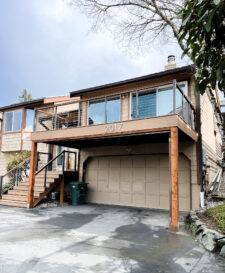
What Whatcom County's Climate Actually Does to a Deck
Whatcom County gets a lot of rain, but it's the combination of factors near Silver Beach that shortens deck lifespans specifically:
- Salt and mineral-laden air off the lake accelerates corrosion on fasteners, joist hangers, and any exposed metal hardware — this is often the first thing to fail, well before the decking boards themselves.
- Driving rain during fall and winter storms doesn't just fall straight down; it gets pushed sideways and up under railings, ledger boards, and stair stringers, finding gaps that a calmer climate would never expose.
- Extended moss and algae season means shaded or low-airflow sections of a deck stay damp for months at a time, which is exactly the environment wood rot and slick surfaces need to take hold.
- Tree cover common around Silver Beach properties drops needles and debris into board gaps, which holds moisture against the wood long after a rain event has passed.
None of this means a deck can't last. It means the materials, fasteners, and construction details have to be chosen for this specific environment — not for a generic climate.
Where Silver Beach Decks Typically Fail First
In our experience working this neighborhood, failure rarely starts in the middle of a deck. It starts at the edges and connections:
- The ledger board attachment to the house — the single most common point of hidden rot if it wasn't flashed correctly the first time.
- Support posts at or near grade, where splash-back and soil contact keep the wood wet.
- Joist hangers and fasteners that were never rated for a coastal-adjacent environment.
- Stair stringers, which take direct rain exposure and heavy foot traffic at the same time.
- Railing posts, especially where old caulking has failed and let water track down into the post base.
What a Correct Deck Replacement Involves
Replacing a deck is not just pulling old boards and nailing down new ones. Done right, it starts below the surface.
1. Structural Inspection First
Before we quote a full replacement, we check the ledger board connection, the framing, the post footings, and the grade around the deck. Sometimes what looks like a full teardown is actually a framing repair plus a resurface. We'll tell you honestly which situation you're in — we don't upsell a full replacement when a targeted repair will hold up.
2. Proper Flashing and Water Management
Given how much driving rain this area sees, flashing at the ledger board and any point where the deck meets the house siding is not optional. This is the detail that determines whether your new deck lasts 10 years or 25.
3. Fastener and Hardware Selection
Standard hardware corrodes faster in air with salt content, even at a lake rather than open ocean. We use fasteners and structural connectors rated for corrosive-resistant applications, not the minimum-cost option, because replacing a deck's structure twice in fifteen years costs more than doing it right once.
4. Grade and Drainage Around Posts
If the original deck was built with posts sitting in standing water after every storm, we address that during replacement — regrading, adding gravel, or adjusting footing depth — rather than just repeating the same setup with new lumber.
5. Decking Material Matched to Moss and Moisture
We'll walk you through the real trade-offs between wood and composite decking for a shaded, damp lot like many in Silver Beach — more on that below.
Decking Material Comparison for Silver Beach Conditions
| Material | Moss/Algae Resistance | Maintenance | Typical Lifespan Here |
|---|---|---|---|
| Pressure-treated wood | Moderate — needs regular cleaning and sealing to resist growth in shaded areas | Annual cleaning and re-sealing recommended | 10–15 years with upkeep |
| Cedar | Good natural resistance, but still needs sealing in damp, shaded spots | Periodic sealing; watch for graying without maintenance | 15–20 years with upkeep |
| Composite decking | Strong resistance to moss staining; surface doesn't absorb moisture like wood | Occasional washing, no sealing or staining | 25+ years, varies by product warranty |
There's no universally "correct" choice — a wood deck under a full sun exposure with good airflow can perform well for decades. But on a shaded, tree-covered Silver Beach lot with year-round moisture, composite often makes more sense simply because it doesn't give moss the organic surface it needs to grow into. We'll give you our honest read on your specific lot rather than pushing one material across the board.
Our Process, Start to Finish
- On-site assessment. We look at the existing deck's framing, ledger connection, post condition, and drainage — not just the surface boards.
- Honest scope conversation. We tell you what actually needs replacing versus what can be repaired, and why.
- Written estimate. Clear pricing with material options laid out, no vague allowances.
- Demolition and disposal. Old decking and framing removed and hauled off — your yard isn't left with a pile of debris.
- Framing correction. Any rotted joists, posts, or ledger issues addressed before a single new board goes down.
- Flashing and hardware installation. The water-management details that determine long-term performance.
- Decking installation. Boards, railings, and stairs installed to code, with attention to gaps and fastening patterns suited to wet-climate expansion and contraction.
- Final walkthrough. We go over care recommendations specific to your deck's sun and shade exposure.
Timeline Expectations
Most standard residential deck replacements in Sudden Valley and Silver Beach take a few days to just over a week, depending on size, whether framing repairs are needed, and weather windows — winter jobs sometimes need to work around storm days. We'll give you a realistic timeline once we've assessed your specific deck, not a generic promise.
Permits and Code Considerations
Deck replacements involving structural changes — new footings, altered height, or attached railings — typically require a permit through Whatcom County. Simple like-for-like resurfacing on sound existing framing sometimes doesn't. We'll tell you which category your project falls into and handle the permit process if one is required, rather than leaving you to figure it out.
Why a Crew That Already Works Silver Beach Matters
Deck replacement isn't a one-size-fits-all job, and this neighborhood isn't a generic climate. A crew that's worked here repeatedly already knows:
- Which lots hold moisture longest into spring and need extra grading attention.
- Which hardware actually holds up near the water versus what fails within a few seasons.
- How local permitting works for waterfront-adjacent properties.
- What driving-rain exposure does to ledger connections that weren't flashed properly the first time.
That local familiarity shows up in fewer surprises during the job and a deck that's actually built for where it sits, not for a textbook climate.
Signs You Need a Replacement, Not a Repair
- Soft or spongy spots when you walk across the deck
- Visible rot at the ledger board, posts, or stair stringers
- Persistent moss or algae that returns within weeks of cleaning
- Rusted or corroded fasteners and hardware
- Boards that have cupped, split, or pulled away from fasteners
- Railings that feel loose or wobble under light pressure
If you're seeing one or two of these, a repair might still be the right call. If you're seeing several at once, especially structural ones like soft framing or a compromised ledger connection, replacement is usually the more honest recommendation — and the safer one.
Get a Straightforward Estimate
If your Silver Beach deck is showing its age, we're happy to come take a look and give you a clear, no-pressure assessment of what it actually needs — repair, partial rebuild, or full replacement. Fill out the form below and we'll get you a straightforward estimate based on what your deck and your lot actually require.