 Sudden Valley Siding
 Roofing in Alger: A Different Set of Problems Than a Roof Twenty Miles Inland
Alger sits close enough to the water that salt-laden air is part of daily life, and far enough into the Skagit and Whatcom County foothills that shade, moisture, and slow-drying roof surfaces are constant. That combination is tougher on an asphalt shingle roof than most homeowners realize. It's not one big problem — it's several small ones working on the roof at the same time, year after year.
Salt air accelerates corrosion on exposed metal — nails, flashing, vent caps — long before the shingles themselves show their age. Driving rain, especially when it comes sideways off a windstorm, finds every weak lap and undersized flashing detail a roof has. And a long moss season, stretched out by the shade and dampness common in this area, holds water against the shingle surface for weeks at a time instead of letting it dry out between storms. A roof built for a drier climate, or installed without those three factors in mind, wears out here faster than it should.
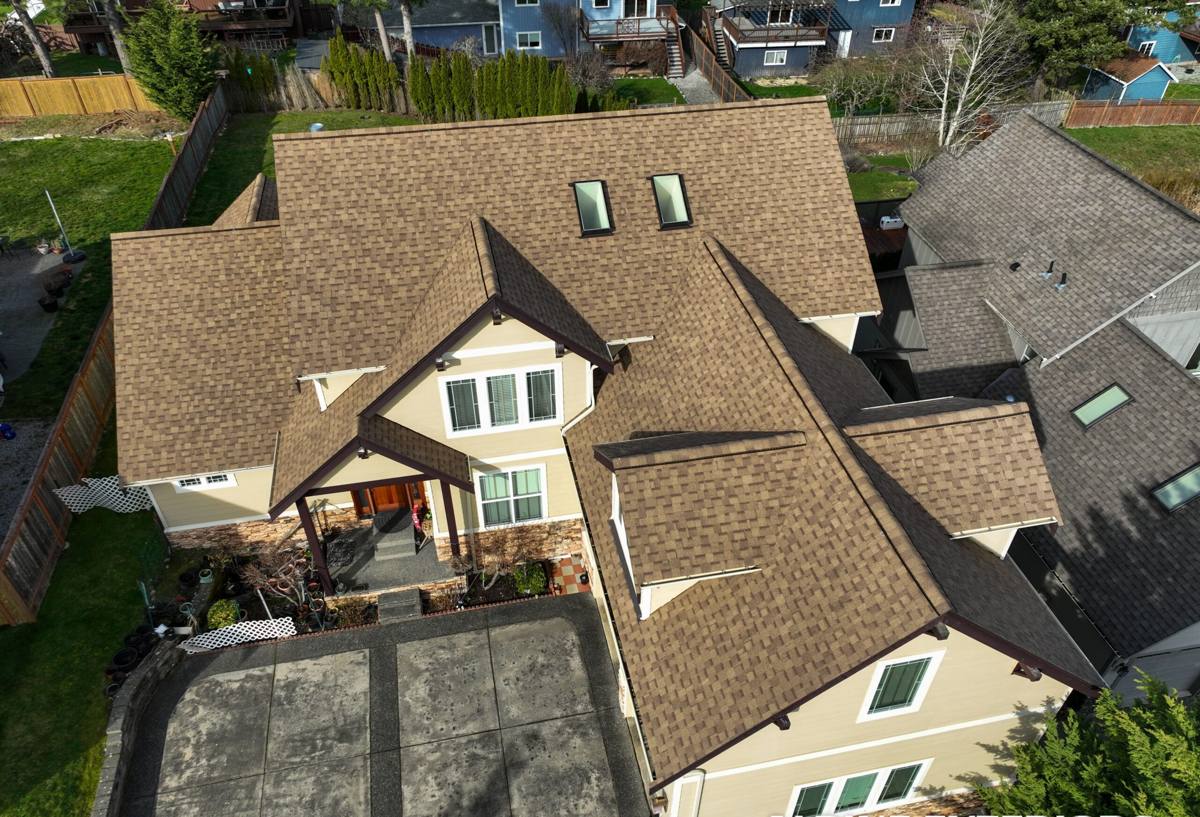
What Salt Air Actually Does to a Shingle Roof
People tend to picture salt damage as something that happens right on the coastline, but moist, salt-carrying air travels a lot further than that, and it doesn't need direct ocean spray to do damage. On an asphalt shingle roof, the exposed metal components are usually the first to show it:
- Roofing nails with worn or thin galvanizing can rust at the head, which loosens their grip on the shingle over time
- Flashing around chimneys, skylights, and sidewalls corrodes at the seams before it corrodes anywhere else
- Metal drip edge and gutter hardware pit and streak, sometimes staining the shingles below
- Exposed fastener heads on ridge caps and vents are a common early failure point if the wrong fastener was used
None of this means asphalt shingles are the wrong choice for Alger — they're not. It means the metal components underneath and around them need to be corrosion-resistant from day one, because replacing a shingle is easy and replacing hidden flashing after the fact is not.
Driving Rain and Why Underlayment Choice Matters Here
Asphalt shingles are a lapped, shed-water system — they're designed to handle rain falling straight down, running off in sheets. Driving rain, pushed sideways by wind, behaves differently. It can work its way up under a shingle tab, along a valley, or around a poorly sealed penetration, especially on a roof with low-pitch sections or long, unbroken valleys.
That's why underlayment isn't a place to cut corners on a roof in this area. A synthetic underlayment with good lap adhesion, combined with self-adhered ice-and-water membrane at valleys, eaves, and around every penetration, gives the roof a real second line of defense. On a lot of older Alger roofs we look at, the shingles are still doing their job but the felt underneath has failed or was never upgraded — and that's usually where the leak is actually coming from, not the shingles themselves.
Where Driving Rain Finds Weak Spots First
- Valleys — especially closed-cut valleys with worn shingle overlap
- Chimney and skylight step flashing with degraded sealant
- Low-slope sections tied into a steeper main roof
- Eaves without ice-and-water membrane, where wind-driven rain can back up under the first course
Moss: The Slow Damage Nobody Notices Until It's Expensive
A long moss season doesn't announce itself the way a leak does. It builds quietly, usually on north-facing slopes or under tree cover, and it does its damage in three ways: it holds moisture against the shingle mat, it lifts shingle edges as it grows, and it traps organic debris that keeps the surface wet even longer than the moss alone would. By the time moss is visible from the ground, it's often already been growing under the shingle tabs for a season or two.
The fix isn't just a one-time cleaning. It's a combination of removal done the right way — never pressure-washed, which strips granules and shortens shingle life — plus zinc or copper control strips at the ridge that let rain carry a small amount of metal ion down the roof slope each time it rains, which keeps new growth from taking hold. On a re-roof, we build that control into the job. On an existing roof, it can often be added without a full tear-off.
Reading the Warning Signs on an Alger Roof
Most asphalt shingle roofs give warning before they leak. Knowing what to look for from the ground, or from inside the attic, buys time to plan a repair or replacement instead of reacting to water damage.
| What You See | What It Usually Means |
|---|---|
| Moss or dark streaking on north-facing slopes | Moisture retention has started; growth control and cleaning are due |
| Granules collecting in gutters | Shingle surface is wearing down; more common near the end of a shingle's service life |
| Curling or cupping shingle edges | Aging, heat cycling, or ventilation problems underneath |
| Rust streaks below flashing or vents | Corrosion on exposed metal — a sign the metal components need attention |
| Daylight or staining in the attic near penetrations | Underlayment or flashing has already failed at that spot |
What a Correct Asphalt Shingle Roof Install Involves
A roof that's going to hold up to salt air, driving rain, and a long moss season needs more than shingles nailed to a deck. Every layer matters, and skipping or downgrading one layer to save money up front usually shows up as a callback within a few years.
The Layers That Actually Do the Work
- Deck inspection and repair — soft, delaminated, or water-stained sheathing gets replaced before anything goes back down, not covered up
- Ice-and-water membrane at eaves, valleys, and penetrations, sized generously rather than to the minimum code requirement
- Synthetic underlayment across the field of the roof for a durable, well-lapped water barrier
- Corrosion-resistant flashing and fasteners at every chimney, skylight, sidewall, and vent
- Balanced attic ventilation — intake at the eaves and exhaust at the ridge, so moisture doesn't condense on the deck from underneath
- Algae-resistant shingles with copper or zinc granules, plus ridge control strips, to slow moss and moss-related staining
- Proper nailing pattern — correct nail count, placement, and depth, since under- or over-driven nails are one of the most common causes of early shingle failure and wind loss
Choosing an Asphalt Shingle Product for This Climate
Not every asphalt shingle is built the same, and for Alger's conditions, some features matter more than others. We don't push a specific brand — we look at wind rating, algae resistance, and warranty structure, and match that to the roof's exposure and slope.
| Shingle Type | Typical Fit for Alger Conditions |
|---|---|
| Standard 3-tab | Lower upfront cost, but lower wind rating and less algae resistance — a harder fit for exposed or shaded slopes |
| Architectural (laminate) | Heavier, better wind rating, thicker mat for durability — our usual recommendation here |
| Algae-resistant (AR) granule shingles | Worth the upgrade on any slope that sees regular shade or moisture, which is most of them in this area |
| Impact-resistant (Class 4) | Not a climate necessity here, but can affect insurance premiums — worth a conversation depending on your policy |
Our Process for an Alger Roofing Project
- On-site inspection — we get on the roof, check the attic, and look at flashing, ventilation, and deck condition, not just the shingle surface
- Honest scope and estimate — repair, partial re-roof, or full replacement, explained in plain terms with the reasoning behind it
- Tear-off and deck check — old material comes off, and any compromised sheathing gets replaced before we move forward
- Underlayment and flashing — ice-and-water membrane, synthetic underlayment, and new corrosion-resistant flashing installed to current best practice
- Shingle installation — correct nailing pattern, proper exposure, and ridge control strips for moss resistance
- Ventilation check — intake and exhaust balanced so the new roof isn't fighting trapped attic moisture from day one
- Cleanup and final walkthrough — magnetic sweep for stray fasteners, gutters checked, and a walkthrough of what was done and why
What Drives the Cost of a Shingle Roof in This Area
| Factor | Why It Matters Here |
|---|---|
| Roof pitch and access | Steeper or harder-to-access roofs take longer and need more safety setup |
| Deck condition | Hidden rot from long-term moisture or moss cover often isn't known until tear-off |
| Shingle grade chosen | Architectural and AR-rated shingles cost more upfront but hold up better against moss and wind |
| Flashing and ventilation scope | Older roofs often need more flashing and vent work than a straightforward reshingle |
| Number of penetrations | Chimneys, skylights, and multiple vent stacks each add labor and material |
We give a written estimate after seeing the roof in person — not a phone quote — because deck condition and flashing scope can change the number significantly, and we'd rather tell you that upfront than adjust it later.
Keeping a New Roof Performing Once It's In
An asphalt shingle roof installed correctly for Alger's climate still needs some basic upkeep to reach its full service life. None of it is complicated, but it does need to happen on a schedule rather than after a problem shows up.
- Keep gutters and valleys clear so water isn't sitting against the shingle edge
- Have moss growth removed gently, never with a pressure washer, as soon as it appears
- Trim back overhanging branches to reduce shade and debris buildup on north-facing slopes
- Schedule a walk-the-roof inspection every couple of years, and always after a major windstorm
- Check attic ventilation isn't blocked by insulation or storage, since airflow protects the deck from underneath
Why It Matters That We Already Work in Alger
A roofing crew that only sees a handful of jobs in this area every year doesn't build the same instinct for what fails first here. Knowing that a north-facing slope under trees is going to need moss control from day one, that certain flashing details need upgrading regardless of what's on the roof already, and that fastener quality matters more here than it does further inland — that comes from doing this work locally and repeatedly, not from a general roofing checklist. It also means we're a known, findable crew if a warranty question or a storm-related repair comes up down the road, not a name from a one-time flyer.
If you're dealing with visible moss, a suspected leak, or a roof that's simply getting old and you want an honest read on where it stands, we're happy to take a look. Reach out for a free, no-pressure estimate — the form below gets straight to us.