 Sudden Valley Siding
 South Hill's Climate Is Hard on Decks
If you own a home in South Hill, you already know your deck doesn't get an easy life. Salt air drifting in off the water, driving rain that can last for days at a time, and a moss season that seems to stretch longer every year all work against wood and fasteners year-round. None of that damage happens overnight — it happens slowly, underneath the boards, at the ledger connection, and inside the framing where you can't see it until a board finally gives way underfoot.
Whatcom County's climate is part of what makes this area beautiful, but it's also exactly the kind of environment that shortens the life of an outdoor structure that isn't built or maintained correctly. A deck that was fine ten or fifteen years ago may already be past the point where repair makes sense. Understanding why that happens is the first step in deciding whether your deck needs patching or full replacement.
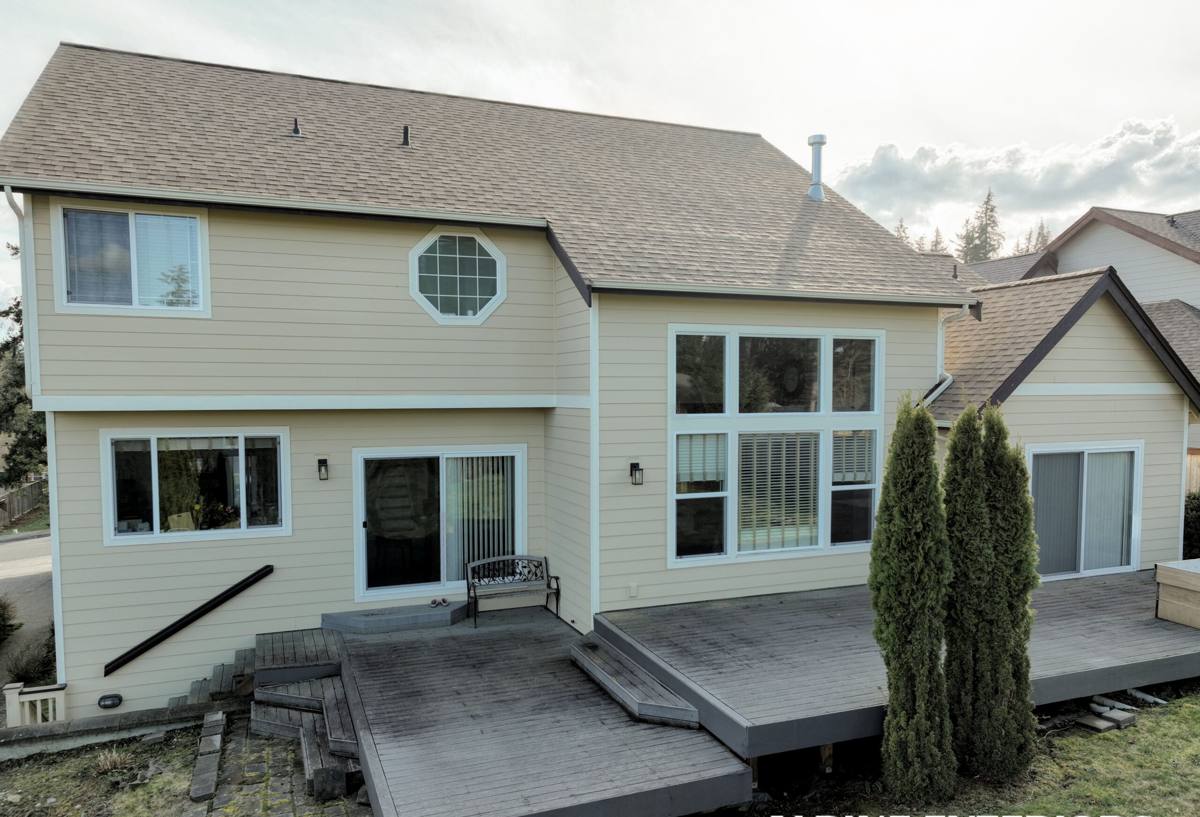
Repair or Replace? Signs It's Time
Not every deck problem calls for a full teardown. Loose boards, a squeaky step, or a railing that's worked itself loose over the years can often be fixed. But there's a point where repairing a deck piece by piece costs more over time than replacing it once, correctly — and where patching over a real problem just hides it for another season.
- Soft, spongy, or springy spots when you walk across the deck
- Rot or dark staining where the deck attaches to the house (the ledger board)
- Fasteners that are rusted, streaking, or pulling loose from the wood
- Railings or posts that wobble, even slightly, when pushed
- Persistent moss or algae that comes right back within weeks of cleaning
- Visible gaps or gapping flashing where the deck meets the siding
- Footings or posts that look like they've shifted, sunk, or heaved
- A deck older than 15–20 years that hasn't been resealed or inspected in years
If you're seeing two or more of these, it's worth having someone look at the structure underneath, not just the surface boards. A lot of deck failures in this climate start below the decking, where moisture sits against untreated or poorly flashed framing long before anything looks wrong from the top.
What a Correct Deck Replacement Actually Involves
A deck replacement done right isn't just swapping old boards for new ones. It's a chance to fix the parts of the structure that caused the original deck to fail in the first place — which matters a lot in a place where rain and damp air are the norm, not the exception.
The Substructure Most Homeowners Never See
Footings, posts, beams, and joists carry the whole load of the deck, and they're the parts most likely to be undersized, under-spaced, or under-protected on an older build. When we replace a deck, we evaluate the footing depth and condition, post spacing, joist size and spacing, and whether the framing lumber is rated for ground contact or exposed use where it needs to be. Framing that was adequate by the standards of 20 or 30 years ago often doesn't hold up to current expectations for wet-climate durability.
Ledger Board and Flashing
The ledger board — where the deck bolts into the house — is the single most common point of failure on decks in wet regions, and it's almost always a flashing problem, not a wood problem. Water works its way behind poorly flashed ledger boards and sits there against the house framing, out of sight, for years. A correct replacement re-flashes this connection properly, with materials and a lap sequence that actually shed water away from the house rather than trapping it.
Choosing the Right Decking Material for This Climate
There's no single "best" decking material for every South Hill home — it depends on your budget, how much maintenance you're willing to do, and how long you want the deck to last before its next major service. Here's how the common options actually perform in a wet, moss-prone climate like this one.
| Material | Moisture Behavior | Maintenance Needed | Relative Upfront Cost |
|---|---|---|---|
| Pressure-treated lumber | Resists rot when properly sealed and maintained; can still cup, crack, or split over time | Regular cleaning and resealing, roughly every 1–2 years | Lowest |
| Cedar | Naturally more rot- and insect-resistant than untreated wood, but still absorbs moisture over time | Periodic cleaning, staining or sealing to maintain color and protection | Mid-range |
| Capped composite decking | Doesn't absorb moisture the way wood does; less prone to rot, splintering, or cupping | Occasional cleaning to prevent moss and algae buildup on the surface | Higher upfront, but no sealing or staining cycle |
We won't push composite on you if wood fits your budget and you're prepared to keep up with sealing — plenty of well-maintained wood decks in this area last for decades. What we do push back on is any material installed without the framing and flashing details to support it. The best decking board in the world will still fail early if it's sitting on a substructure that's trapping moisture underneath.
Our Deck Replacement Process
- On-site assessment — we inspect the existing deck, ledger connection, footings, and framing to determine what's actually driving the failure, not just what's visible from the surface.
- Honest scope and options — we walk you through material choices, what your budget realistically buys, and what we'd recommend for a South Hill property specifically.
- Permitting — where a permit is required, we handle the paperwork and inspections so nothing gets built that has to be torn out later.
- Demolition and disposal — the old deck comes out, including any rotted framing, so we're not building new work on top of old problems.
- Framing and flashing — footings, posts, beams, joists, and ledger flashing are installed or upgraded to current standards for this climate.
- Decking, railings, and stairs — installed to manufacturer spacing and fastening specs, which matters for both appearance and how the deck sheds water long-term.
- Final walkthrough — we go over the finished deck with you, including basic care so it holds up through the wet months ahead.
Permits, Codes, and Guardrail Requirements
Deck replacement in Whatcom County typically requires a permit when the deck is attached to the house or above a certain height, though exact requirements can vary by jurisdiction and by the specifics of your property — we confirm what applies to your project rather than assume. Guardrail height, baluster spacing, and stair details are also governed by code, and these aren't areas where it makes sense to cut corners, since they're safety requirements as much as inspection requirements. If you've had a contractor offer to "skip the permit" to save time, that should be a red flag rather than a selling point — an unpermitted deck can create real problems when you go to sell the home.
What Affects the Cost of a Deck Replacement
We don't think broad online price ranges are very useful without seeing the actual site, but the main factors that move the number are consistent from project to project:
| Factor | Why It Matters |
|---|---|
| Deck size and shape | More square footage and more complex layouts (angles, multiple levels) mean more material and labor |
| Decking material | Pressure-treated, cedar, and composite carry different material costs and installation time |
| Condition of the substructure | Rotted framing, undersized footings, or a failed ledger connection add scope beyond just the surface boards |
| Railing and stair style | Custom railings, cable systems, or multiple stair sets add both material and labor |
| Site access | Decks on slopes, near the water, or with limited equipment access can take longer to build |
| Permit and inspection requirements | Adds time and coordination, but protects you at resale and for safety |
Why a Crew That Already Works in South Hill Matters
Building or replacing a deck in this part of Whatcom County isn't the same job as building one somewhere dry. A crew that hasn't worked in this climate might frame and flash a deck the way they would in a drier region — and it may look fine for a few years before the moisture problems that a wet climate causes start to show up. A crew that already works in South Hill and the surrounding Sudden Valley area knows which ledger flashing details actually hold up here, which materials handle the moss and moisture load well, and which shortcuts show up as callbacks two or three winters later.
That local experience also means we're not guessing at what your property is up against. We've seen how decks in this area age, what fails first, and what actually needs to change in the rebuild so you're not solving the same problem again in ten years.
Keeping Your New Deck Looking Good Through Moss Season
A correctly built deck still needs some upkeep in a climate like this one. A few habits go a long way:
- Sweep debris and standing water off the deck surface regularly, especially in fall and winter
- Clean moss and algae buildup before it gets a foothold rather than after it's established
- Keep gutters and downspouts clear so runoff isn't draining onto or under the deck
- Reseal or restain wood decking on the schedule appropriate to that material
- Do a quick annual check of railings, stairs, and fasteners for movement or rust
None of this is complicated, but skipping it is exactly how a well-built deck ends up needing early repairs — the same moisture and moss pressure that wears down an old deck doesn't stop just because the deck is new.
If your deck in South Hill is showing its age, or you just want a straight answer on whether it needs repair or replacement, we're happy to take a look. Fill out the form below for a free, no-pressure estimate.