 Sudden Valley Siding
 Why Decks in Sunnyland Wear Out Faster Than You'd Expect
Sunnyland sits close enough to Bellingham Bay that the air carries a faint salt edge even on inland lots, and that moisture-laden air mixes with the steady, driving rain that defines a Whatcom County winter. Add the tree cover common on older Sunnyland lots and you get decks that stay damp for days after a storm instead of drying out in an afternoon. That combination — salt-tinged humidity, prolonged wetness, and shade — is exactly what accelerates wood decay, corrodes fasteners, and feeds the moss and algae that make boards slick and dark by mid-winter.
A deck built to a generic national spec, without attention to this specific climate, tends to show trouble inside 10-12 years: soft framing, rusted hardware, and a surface that's more moss than wood for a third of the year. A deck built correctly for this region should outlast that by a wide margin. The difference isn't the brand of lumber on the shelf — it's how the ledger is flashed, how the frame drains, and what fasteners go into it.
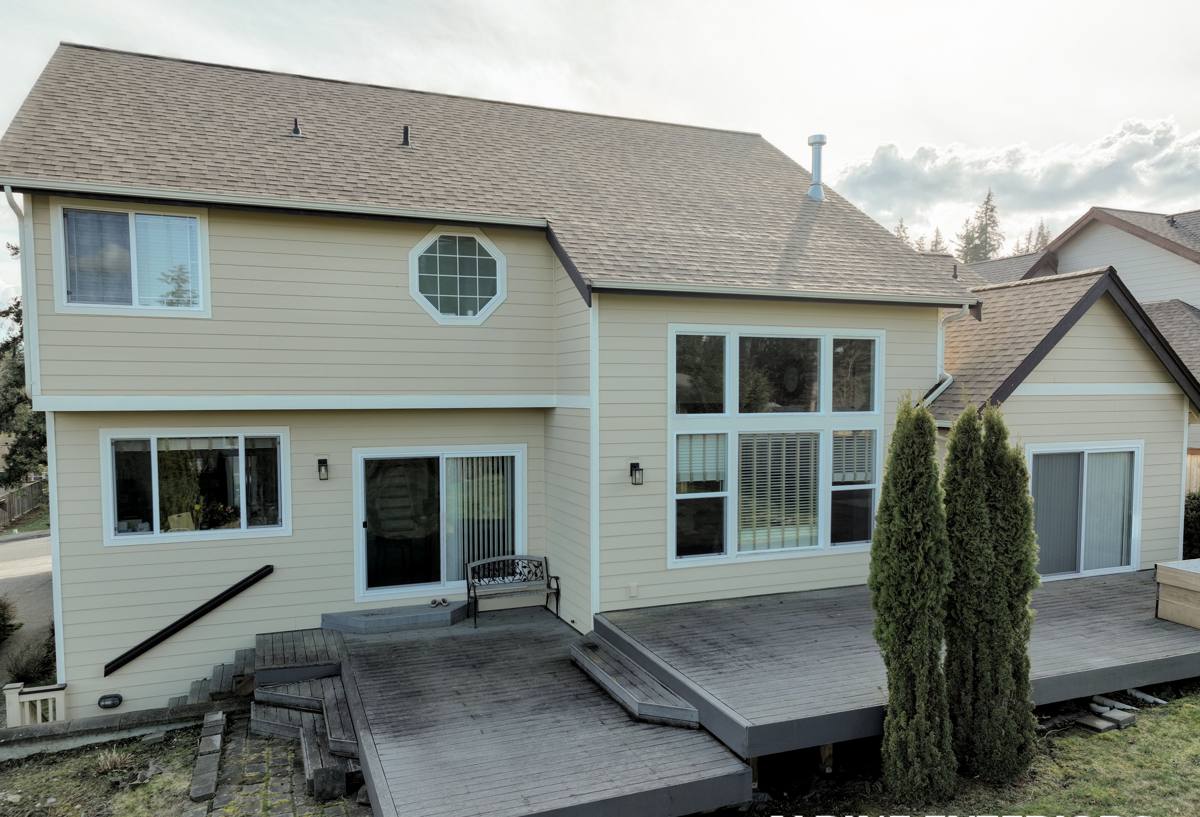
Repair or Replace? Signs Your Deck Has Passed the Point of Patching
Homeowners often call us wanting a few boards swapped, and sometimes that's genuinely all it takes. But in this climate, surface rot is frequently a symptom of a structural problem underneath — and patching over it just hides the issue for another season.
- Boards that feel spongy or flex noticeably underfoot, especially near the house
- Dark staining or soft wood where the deck meets the ledger board (the board bolted to your house)
- Rust streaks bleeding out from screws or nails, or fasteners that back out on their own
- Posts or railings that wobble, lean, or have visibly separated from their footings
- Gaps between boards that have widened well beyond their original spacing
- Persistent green or black growth that returns within weeks of cleaning
- Visible daylight or gaps where the ledger board meets the house siding
Any one of these on its own might mean a repair. Two or more together, particularly involving the ledger or framing, usually means the deck's structure has been compromised and a full rebuild is the honest recommendation.
What a Correct Deck Replacement Actually Involves
Ledger Board and Flashing
The ledger board — where the deck attaches to the house — is the single most common failure point in this region, and it's almost never a visible problem until the damage is already done. Water that gets behind an improperly flashed ledger doesn't just rot the deck; it can rot the house's rim joist and sheathing behind the siding. A correct replacement means removing the old ledger connection entirely, inspecting the framing behind it, and installing proper flashing that sheds water away from the house rather than trapping it against the wall.
Framing and Joist Protection
Every joist top gets a self-adhering flashing tape before decking goes down. It's a small material cost that prevents water from sitting in the screw holes and wicking into the joist for years — which is exactly how framing rots from the inside while the surface still looks fine. Framing lumber should be an appropriate treated grade for ground contact where required, with spacing and blocking that lets air move underneath the deck instead of trapping moisture.
Footings and Posts
Footings need to sit below the frost line and bear on undisturbed soil, with post bases that hold the post itself up off the concrete — wood sitting directly on concrete wicks moisture continuously and rots from the base up, even with treated lumber. Any footing showing heaving or cracking during demo gets replaced, not reused.
Guardrails and Stairs
Guardrail height, baluster spacing, and graspable handrail profiles are all governed by code, and stair rise/run consistency matters as much for safety as for inspection sign-off. Replacement is the right time to correct any of these if the old deck was built before current code or simply built wrong.
Choosing Decking Material for a Wet, Mossy Climate
There's no single "best" decking material — there's a best fit for how much upkeep you want to do and how the deck sits relative to shade and moisture. Here's how the common options actually perform in Whatcom County conditions:
| Material | Moisture & Moss Behavior | Maintenance | Typical Lifespan Here |
|---|---|---|---|
| Pressure-treated lumber | Resists rot when properly sealed and ventilated underneath; still hosts algae/moss if shaded | Annual cleaning and resealing recommended | 15-20 years with upkeep |
| Cedar | Naturally decay-resistant, ages gracefully, but softer surface stains faster in constant damp | Cleaning plus periodic oil or stain | 15-25 years with upkeep |
| Composite/PVC boards | Won't rot or splinter; textured surfaces can still hold moss film if never cleaned | Occasional rinse/wash, no sealing or staining | 25-30+ years, manufacturer-dependent |
For heavily shaded Sunnyland lots where a deck rarely sees direct sun, we generally steer homeowners toward composite or PVC boards for the framing-level surface, simply because the maintenance burden of keeping wood sealed in constant shade is real and ongoing. That's a trade-off judgment, not a knock on wood — plenty of well-maintained cedar decks in this area look great for decades. It comes down to how much time you want to spend on upkeep versus upfront cost.
Permits and Building Requirements
Most deck replacements that involve rebuilding the structure — not just swapping surface boards — require a permit through the local building department, particularly when footings, framing, or guardrails are being altered. This isn't a formality to skip; an unpermitted structural rebuild can complicate a future home sale and, more importantly, skips the inspection step that catches framing or flashing mistakes before they're buried under decking. We handle the permit process as part of a full replacement and build to current code rather than matching whatever the old deck happened to be.
Our Deck Replacement Process
- On-site assessment — we inspect the existing ledger, framing, and footings, not just the surface boards, so the estimate reflects what's actually there
- Tear-off — full removal of the old deck, with the ledger connection and rim joist checked for hidden rot behind the siding
- Framing rebuild — new ledger flashing, joist tape, code-compliant footings and post bases, proper drainage spacing
- Decking installation — your chosen material installed with correct fastening and gapping for seasonal movement
- Railings and stairs — built or replaced to current code, matched to the house's style
- Final walkthrough — we go over the finished deck and what maintenance it needs before we consider the job done
Maintenance Checklist to Protect Your New Deck
- Keep gutters and downspouts clear so runoff isn't dumping directly onto the deck
- Sweep leaves and debris off the surface and out of board gaps regularly through fall
- Rinse moss and algae film off before it has a chance to establish, especially in shaded corners
- If you chose wood, reseal or restain on the schedule your product calls for — don't wait until it visibly needs it
- Keep planters and rugs from sitting in one spot for months at a time; both trap moisture underneath
- Do a quick fastener and railing check each spring before the deck sees heavy use again
Cost Factors in a Sunnyland Deck Replacement
| Factor | How It Affects the Job |
|---|---|
| Deck size and elevation | Larger decks and multi-level or elevated decks need more framing, footings, and stair structure |
| Decking material | Composite/PVC costs more upfront than wood but less in maintenance over time |
| Condition of existing structure | Rotted ledger, framing, or footings found during tear-off add rebuild scope beyond surface replacement |
| Railing and stair complexity | Custom railing styles or multiple stair runs add labor and material |
| Permit and engineering needs | Larger or structurally altered decks may need engineered footing or beam specs |
We give a written estimate after the on-site assessment, broken down clearly enough that you can see what you're paying for — there's no value in a number that doesn't survive tear-off.
Why a Crew That Already Works This Neighborhood Matters
Sunnyland's mix of mature tree cover, sloped lots, and proximity to the bay means the moisture and drainage challenges here aren't identical to a deck job across town. A crew that's already worked decks in this neighborhood knows to expect shaded framing that stays wet longer, understands how local soil drains around footings, and isn't guessing at how much moss pressure a north-facing deck will see. That familiarity shows up in fewer surprises during tear-off and a build that's actually sized to the conditions your yard creates — not a one-size-fits-all approach carried over from a drier part of the state.
If your deck is showing its age, we're happy to take a look and give you a straight answer about whether it needs repair or full replacement. Reach out for a free, no-pressure estimate using the form below.