 Sudden Valley Siding
 Why South Hill Decks Work Harder Than the Brochure Suggests
Composite decking is sold as a low-maintenance upgrade over wood, and in most parts of the country that's a fair claim. In the South Hill area of Sudden Valley, the claim only holds if the deck is actually built for the conditions here. Homes on this side of Whatcom County deal with a combination that's harder on outdoor structures than most manufacturers' install guides assume: salt-tinged marine air moving in off the water, driving rain that comes in sideways during fall and winter storms, and a moss season that can stretch from October well into spring. Composite boards handle moisture better than wood, but "better than wood" is not the same as "immune to it." The substructure underneath, the fasteners holding it together, and the airflow beneath the deck all still matter — arguably more than the board brand printed on the warranty card.
We've built and repaired decks around Sudden Valley long enough to know where composite decks in this neighborhood actually fail. It's almost never the board surface. It's the framing that was never rated for wet-dry cycling, the ledger board that was flashed like a dry-climate deck, or the gap spacing that was set for a summer install and closed up tight by the time the winter rains hit.
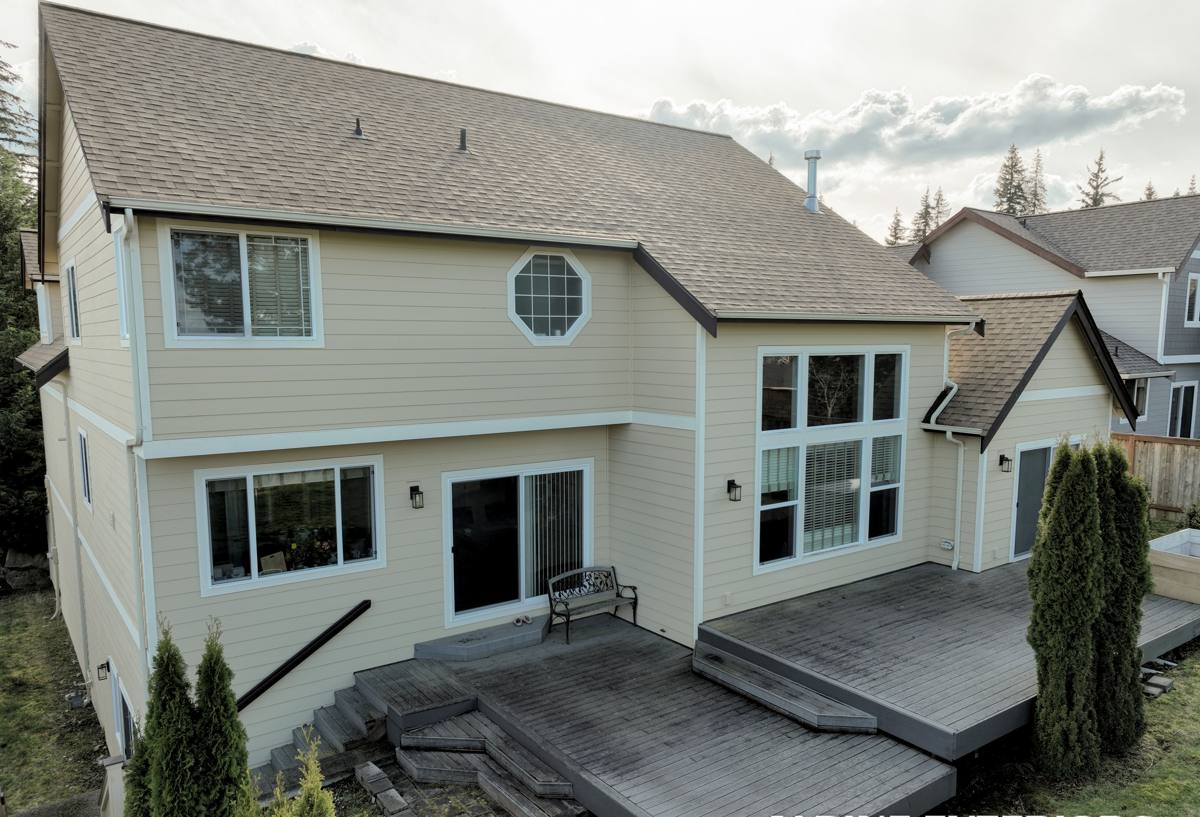
What the Regional Climate Actually Does to a Deck
Salt-influenced moisture
Even at a distance from open saltwater, the marine air that moves through this part of Whatcom County carries enough salinity to accelerate corrosion on the wrong hardware. Standard zinc-coated screws and brackets can start showing rust streaks on composite boards within a couple of seasons. Once that happens, the staining is on the deck surface, not just the fastener — and composite boards don't sand out like wood does.
Driving rain and wind-driven water
Storms here don't always come straight down. Wind-driven rain gets pushed under rail caps, into end-grain cuts, and along ledger connections that a calmer climate could get away with sealing loosely. Any composite deck attached to the house needs flashing detail that assumes water will hit it sideways, not just fall on top of it.
The long moss season
Moss and algae need shade, moisture, and time — South Hill's tree cover and damp winters supply all three for months at a stretch. Moss on a wood deck rots the fibers it grows on. Moss on composite decking doesn't rot the board, but it does hold moisture against the surface, stains the cap layer, and turns boards slick and genuinely dangerous underfoot on stairs and ramps. Board spacing, slope, and airflow underneath the deck all affect how fast moss takes hold and how easy it is to knock back.
What a Correctly Built Composite Deck Involves
Substructure
Composite boards are only as good as what's under them. In this climate we build the frame with lumber and hardware rated for sustained wet exposure, not the minimum grade that passes inspection in a drier region. Joist spacing gets tightened from typical wood-deck spans, since most composite manufacturers require closer joist centers than dimensional lumber to prevent sagging over time.
Ledger and flashing
Where the deck attaches to the house, the ledger board is the single most common point of long-term water damage on any deck, composite or not. A correct ledger installation includes proper flashing that sheds water away from the house band board, not sealant alone. Sealant fails; flashing doesn't rely on staying intact for twenty years to keep water out.
Ventilation and drainage below deck
A composite deck built tight to the ground, or over poorly graded soil, traps moisture underneath where it can't dry out between rain events. That trapped humidity feeds moss and mildew on the underside of boards and around post bases. Correct builds account for airflow and drainage path from day one, not as an afterthought once the boards are down.
Fasteners and hardware
Hidden fastener clip systems are common on composite decks for a clean surface look, but the clips and screws underneath need to be rated for the specific moisture and salt exposure of this area — not just "outdoor rated" in general. We match fastener grade to the board manufacturer's spec and to what actually holds up in Whatcom County conditions, since a warranty on the boards doesn't cover corrosion damage caused by the wrong screw.
Composite vs. the Alternatives
Composite isn't automatically the right call for every deck, but here's how it stacks up against the materials most South Hill homeowners are actually choosing between:
| Material | Moisture Behavior Here | Moss/Algae Resistance | Maintenance Burden |
|---|---|---|---|
| Composite (capped) | Doesn't rot; core can still absorb moisture at cut edges if not capped/sealed | Surface resists staining better than wood but still needs periodic cleaning | Low — occasional wash, no yearly sealing |
| Pressure-treated wood | Absorbs and releases moisture constantly; prone to cupping and splitting in wet-dry cycles | Moss embeds in grain and accelerates rot | High — sealing/staining every 1-2 years |
| Cedar | Naturally moisture-resistant but still an organic material that weathers | Susceptible to moss in shaded, damp spots | Moderate to high — regular treatment to hold color and resist decay |
| PVC (cellular) | Fully moisture-resistant, no organic core to absorb water | Similar surface staining risk to composite; cleans up easily | Low, but higher material cost and different expansion behavior in temperature swings |
For most South Hill homes, capped composite is the practical middle ground: meaningfully lower upkeep than wood, without the higher material cost or different handling requirements of full PVC systems. The trade-off is that composite still needs to be installed with moisture-smart detailing — it isn't a material that forgives a careless build the way people sometimes assume.
Our Process, Start to Finish
- On-site assessment. We look at your home's existing ledger condition, grade and drainage under the proposed deck footprint, sun exposure, and how much tree cover will affect moss growth before we ever talk board colors.
- Design and layout. Board direction, joist spacing, stair placement, and railing choice get set based on both how you want to use the space and how water and airflow will move through the structure.
- Material selection. We walk through composite board lines and finish options with you honestly, including where a given product's warranty terms and installation requirements do or don't fit this climate.
- Framing and flashing. This is the part that determines whether the deck is still solid in ten years — correct ledger flashing, moisture-rated framing lumber, and joist spacing matched to the board manufacturer's span tables.
- Decking installation. Boards are installed with manufacturer-specified gapping to allow for seasonal expansion and drainage, using fastener hardware rated for this area's moisture and salt exposure.
- Rail, stair, and finish details. Final grading checks around post bases and stair stringers to make sure water sheds away from the structure rather than pooling against it.
- Walkthrough and care guidance. We show you what routine maintenance actually looks like for your specific deck — not a generic manufacturer pamphlet.
Cost Factors Worth Understanding Before You Get a Number
Composite decking costs vary a lot based on site conditions, not just square footage. Rather than quote a number that won't match your situation, here's what actually moves the price on a South Hill project:
| Factor | Why It Matters |
|---|---|
| Height and grade of the deck | Elevated decks need more substructure, railing, and often stair work than ground-level decks |
| Ledger and flashing condition | Replacing or upgrading a poorly flashed ledger connection adds labor but prevents future water damage |
| Board tier (capped vs. uncapped, color/finish) | Higher-end capped composite resists moisture and staining better but costs more per board |
| Site access and slope | Sites with limited equipment access or steep grade add labor time for material handling and footings |
| Railing and stair complexity | Multiple stair runs, custom rail systems, or lighting add both material and install time |
| Removal of an existing deck | Tear-out and disposal of an old wood deck is a separate line item from new construction |
We give a written, itemized estimate before any work starts, so you can see exactly where the cost is coming from rather than a single lump-sum number.
Living With a Composite Deck in This Climate
Composite decking's real advantage over wood isn't that it's maintenance-free — it's that the maintenance it needs is simpler and less frequent. In a moss-prone, high-rainfall area like South Hill, that still means:
- Sweeping debris and standing leaves off the deck surface regularly, especially under tree cover where moss gets a head start
- Washing the deck surface once or twice a year with a soft-bristle brush and a composite-safe cleaner to break up algae and moss film before it sets in
- Checking that gaps between boards stay clear so water keeps draining instead of pooling
- Inspecting fastener heads and rail connections periodically for corrosion, especially heading into winter
- Keeping planters and other items that trap moisture off the deck surface for extended periods
None of this is heavy work, but skipping it in this climate lets moss and grime build up faster than it would in a drier region — and once moss embeds itself in a textured composite surface, it's a lot more work to remove than it would have been to prevent.
Why a Crew That Already Works South Hill Matters
A lot of what determines whether a composite deck lasts here comes down to decisions made before the first board goes down: how the ledger gets flashed, how the frame is graded to shed water, what fastener hardware is specified. Those are the same decisions on paper anywhere in the country — but the right answer to each one shifts once you factor in Sudden Valley's rainfall pattern, the tree cover common in this neighborhood, and the salt-air exposure that comes with living in this part of Whatcom County. A crew that's built and repaired decks specifically in this area has already seen what fails here and adjusts for it automatically, instead of applying a generic install spec and hoping it holds up.
Questions to Ask Before You Hire a Deck Contractor
- Are they licensed and insured to do deck construction in Washington State, and will they provide proof?
- Do they pull the required permits for deck construction, or ask you to skip that step?
- Can they explain, specifically, how they'll flash the ledger connection to your house?
- Do they specify fastener and hardware grades rated for this area's moisture and salt exposure, or use whatever's standard elsewhere?
- Will they give you a written, itemized estimate rather than a verbal ballpark?
- Do they have experience with composite board manufacturers' specific installation requirements, including joist spacing and expansion gapping?
- Are they familiar with the drainage and grading needs specific to sloped or tree-covered lots like those common in South Hill?
If you're weighing a new composite deck or replacing an aging wood one, we're happy to walk your property, look at the site conditions that actually matter, and give you a straight, no-pressure estimate. There's no obligation — just an honest look at what your South Hill home needs. Use the form below to get started.