 Sudden Valley Siding
 Why Siding Wears Differently in Sehome
Sehome sits close enough to Bellingham Bay that homes here deal with a steady drift of salt-laden air on top of everything else Whatcom County weather throws at a house. That combination — salt air, driving rain off the Sound, and a moss season that can run eight or nine months out of the year on shaded, tree-covered lots — is harder on exterior siding than most homeowners realize until they're dealing with the results.
Salt air accelerates corrosion on fasteners, flashing, and any metal trim that isn't properly protected. Driving rain, especially the wind-driven storms that come through in fall and winter, doesn't just wet the surface of a wall — it tests every seam, joint, and piece of flashing behind the siding. And moss doesn't just look bad; it holds moisture against the siding surface for months at a time, which is exactly the condition that rots wood-based products and stresses paint films on anything not engineered for it.
None of this means siding fails fast in Sehome. It means siding that isn't matched to this climate — or wasn't installed correctly for it — tends to fail earlier and less gracefully than the same product would in a drier region.
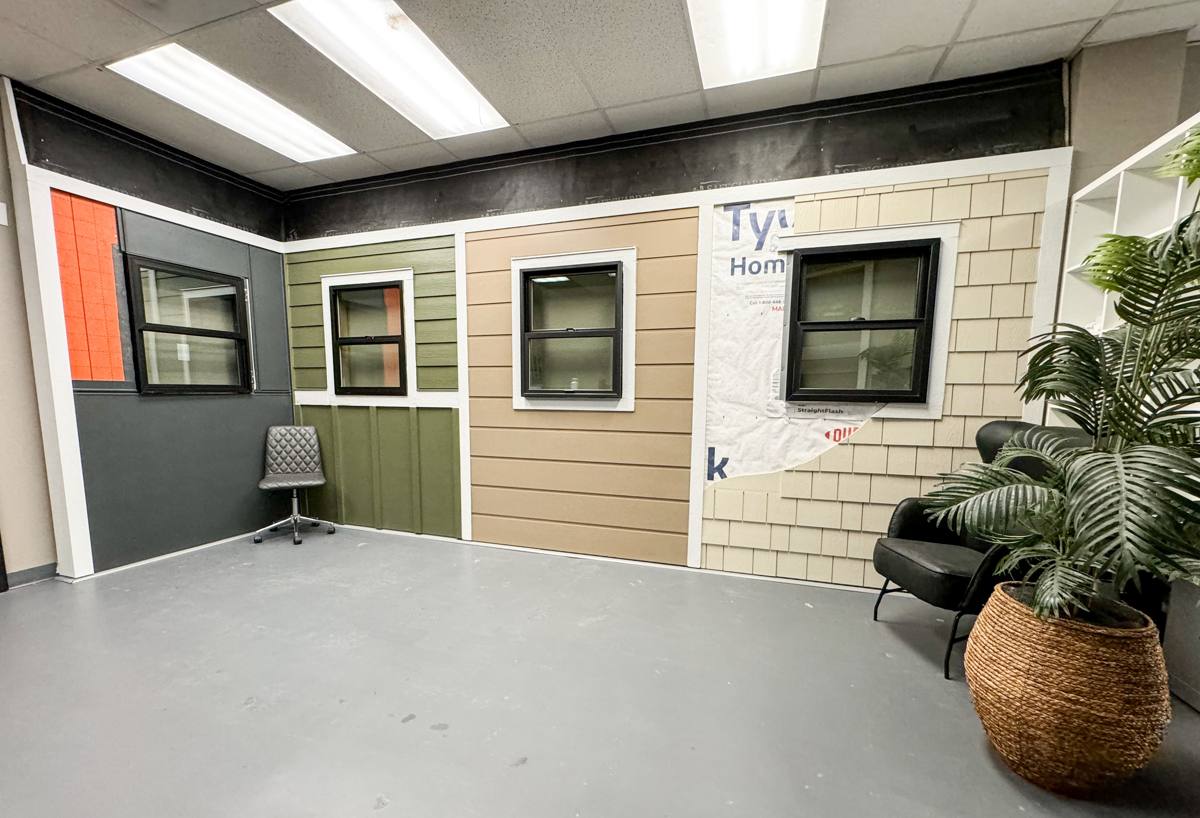
Signs a Sehome Home Needs Siding Replacement
Repainting or spot-patching can buy time, but certain signs mean the siding itself, not just the finish, has reached the end of its service life:
- Moss or algae staining that comes back within a season or two of cleaning
- Soft, spongy, or springy spots when you press on the siding, especially near the bottom courses
- Paint that won't hold anymore — blistering, peeling, or flaking back to bare substrate within a couple of years of a repaint
- Visible warping, buckling, or delamination of panels or boards
- Widening gaps at seams, corners, or trim where caulk keeps failing
- Rot at the bottom edge, around window and door trim, or anywhere siding meets a roofline or deck
- A noticeable rise in heating costs, which can point to moisture-compromised insulation behind failing siding
Any one of these on its own might be a repair. Two or three together, especially on a home more than 15-20 years old, usually means it's time to talk about full replacement rather than continuing to chase individual problem spots.
What a Correct Siding Replacement Job Actually Involves
Siding replacement done right is not just pulling off old boards and nailing up new ones. In a climate like this, most of what determines whether the job lasts happens in the layers you never see again once the new siding is up.
Tear-Off and Sheathing Inspection
Every square foot of old siding comes off so the sheathing underneath can actually be inspected — not just around a few visibly bad spots. In a wet climate, water damage often travels further than it shows on the surface, and sheathing that's soft or delaminated has to be replaced before anything new goes up. Skipping this step is one of the most common ways a siding job fails early, because new siding over compromised sheathing is just a nicer-looking version of the same problem.
Weather-Resistive Barrier and Drainage Plane
A proper weather-resistive barrier, installed with correct overlaps and sealed penetrations, is what keeps wind-driven rain from reaching the wall assembly even when it gets behind the siding surface — which it eventually will, on any home, in this climate. Where conditions call for it, a drainage gap (rain screen) behind the siding gives incidental moisture a path to escape and dry out instead of sitting against the back of the siding.
Flashing at Every Penetration
Windows, doors, hose bibs, vents, and anywhere siding meets a roofline or deck ledger are the places siding jobs actually fail. Correct flashing — installed in the right order relative to the weather-resistive barrier, so water is always directed outward and downward — matters more to the long-term outcome than the siding product itself.
Installation to Manufacturer Spec
Fastener spacing, clearance from grade and rooflines, proper gapping at joints, and correct caulking practices all affect how the siding performs over time. Fiber cement in particular has specific installation requirements around cutting, fastening, and finishing edges — done wrong, they void the manufacturer warranty even if the siding itself is a good product.
Why We Install Only James Hardie Fiber Cement
We standardized on James Hardie fiber cement siding and don't install anything else, and it's worth explaining why rather than just stating it. Fiber cement is non-combustible, which matters to us as a baseline standard regardless of region. It holds paint and factory-applied color far longer than wood-based sidings because it doesn't expand and contract with moisture the way wood products do — which is directly relevant in a climate with this much sustained damp weather and moss exposure.
Hardie's ColorPlus finish is a factory-baked finish, not a field-applied paint job, which gives more consistent, longer-lasting color than site-painted siding — important here because repainting an entire house every few years is exactly the maintenance burden most homeowners are trying to get away from. Hardie also produces climate-specific "HZ" formulations engineered for regional moisture and freeze conditions, and offers a strong transferable warranty when the product is installed by a qualified installer to their spec — which is the other half of why we only install this one system: we know it cold, and we're not guessing our way through a different product's installation quirks on your house.
What About Vinyl, Engineered Wood, or Cedar?
Homeowners in Sehome ask about these regularly, and each one has real strengths worth acknowledging honestly.
Vinyl is inexpensive and low-maintenance in mild, dry climates. In a marine climate with driving rain, vinyl's seams and expansion joints are more vulnerable to water intrusion, and it can warp or become brittle with repeated temperature swings and UV exposure over the years. It's also not repairable in the same way fiber cement is — a damaged section usually means replacing the whole panel run.
Engineered wood products (like LP SmartSide) have improved a great deal and cost less than fiber cement. But they're still wood-based at the core, meaning they remain more sensitive to sustained moisture exposure at cut edges, seams, and any point where the factory coating is compromised — a real concern given how many months a year this area stays damp and how long moss can sit against a wall before anyone notices.
Cedar looks great and has real heritage appeal, but it's the highest-maintenance option of the group: it needs regular refinishing, is the most susceptible to moss and mildew of any siding material, and is combustible. For a homeowner who wants that look without the upkeep, we'll talk about Hardie's textured panel and shingle profiles, which get close to the appearance without the maintenance calendar.
We don't install any of these — not because they're bad products, but because we've chosen to be excellent at one system rather than mediocre across several, and Hardie is the one we believe holds up best to this specific climate over the long run.
Comparing the Options
| Factor | Vinyl | Engineered Wood | Cedar | James Hardie Fiber Cement |
|---|---|---|---|---|
| Upfront cost | Lowest | Lower-mid | Higher | Mid-higher |
| Moisture/moss resistance | Moderate (seam risk) | Moderate (edge risk) | Lower without upkeep | High |
| Combustibility | Melts/deforms in heat | Combustible | Combustible | Non-combustible |
| Repaint/refinish cycle | Rarely painted | Moderate | Frequent | Long (factory finish) |
| Typical lifespan when installed correctly | Moderate | Moderate | Moderate w/ upkeep | Long |
Our Process, From Estimate to Finished Job
- On-site assessment — we look at the current siding, sheathing condition where accessible, trim, flashing, and anything specific to your lot (shade, drainage, exposure to weather off the water).
- Written scope and estimate — what's being torn off, what sheathing repair allowance is built in, which Hardie product line and profile fits the home, and a clear price before any work starts.
- Tear-off and inspection — old siding comes off, sheathing gets inspected and repaired as needed, and we flag anything that changes the original scope before proceeding.
- Weather barrier, flashing, and drainage details — the layers that determine how the job performs in ten years, done to spec before a single piece of new siding goes up.
- Hardie installation — fastened, gapped, and finished to manufacturer specification so the warranty stays intact.
- Final walkthrough — trim, caulking, and touch-up reviewed with you before we call it done.
Why a Crew That Already Works in Sehome Matters
Whatcom County's mix of hillside lots, mature tree cover, and proximity to the water means every neighborhood has its own quirks — which sides of a house stay damp longest, where moss builds up fastest, how much wind-driven rain a given exposure actually takes in winter. A crew that already works in this area isn't guessing at any of that. We know what "correctly installed for this climate" means here specifically, not in the abstract, and that shows up in the details — flashing choices, drainage planning, and product line selection — more than in anything you'd notice on a walk-through the day the job wraps up.
Local experience also means straightforward answers about permitting, realistic timelines around this area's weather windows, and a crew that isn't disappearing to another region if a warranty question comes up five years down the road.
Getting Started
If your Sehome home is showing any of the signs above, or you're just trying to plan ahead before it becomes an emergency repair, we're glad to take a look and give you an honest read on where things stand. There's no pressure and no cost to get a straight answer — fill out the form below and we'll set up a time to walk the property with you.