 Sudden Valley Siding
 Fairhaven's Coastal Climate Is Hard on Siding
Fairhaven sits close to Bellingham Bay, which means homes here take on a combination of stresses that inland Whatcom County properties don't deal with nearly as often. Salt-laden air moves off the water and settles on exterior surfaces, where it accelerates corrosion of fasteners and trim, and slowly breaks down paint film on materials that weren't built to handle it. Add in the driving, wind-pushed rain that comes through in fall and winter storms, and you have moisture being forced sideways into seams and laps rather than just running straight down the wall the way siding is usually tested to handle.
Then there's the moss. Between the shade from mature trees, the marine humidity, and long stretches of overcast, damp weather, Fairhaven's moss season runs longer than it does in drier parts of the county. Moss and algae hold moisture directly against the siding surface for extended periods, and on the wrong material that constant dampness is exactly what shortens a siding job's life. None of this is exotic or unusual — it's just what a temperate coastal climate does to a house, year after year, and it's the baseline we design every installation around.
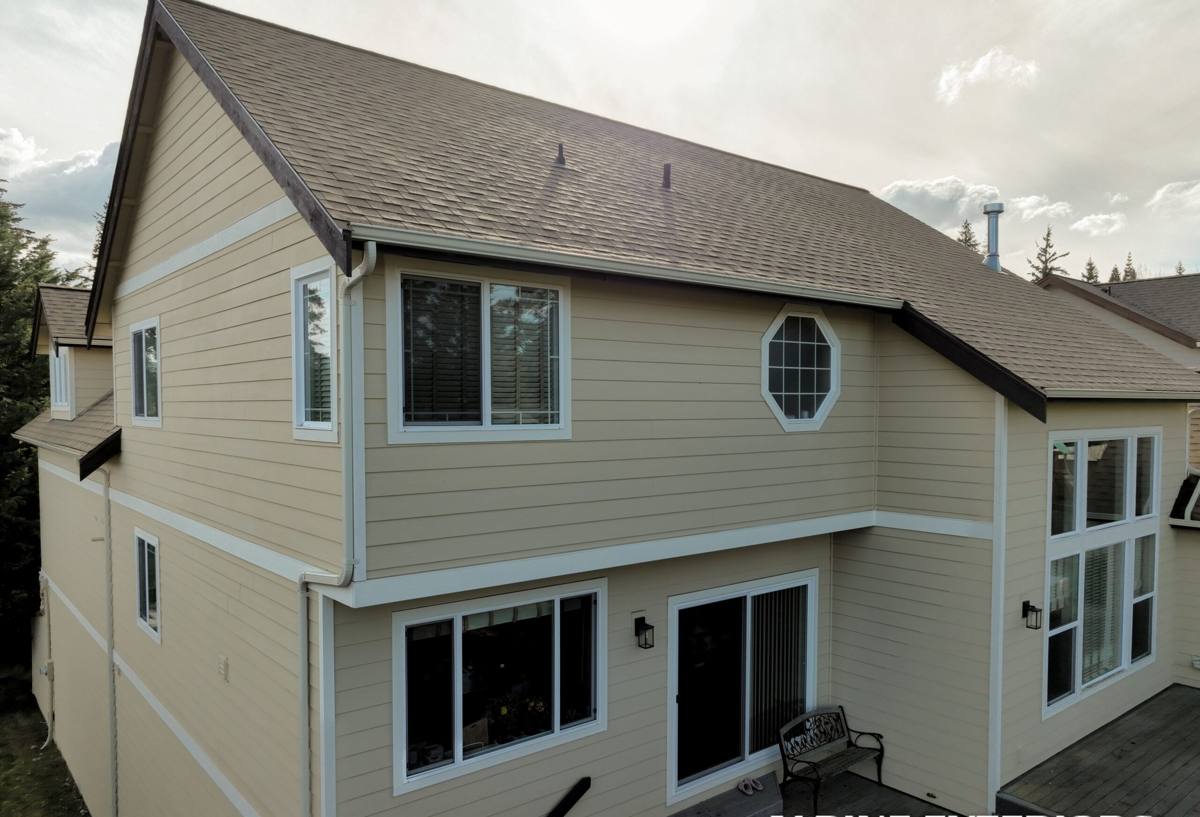
What Fairhaven Homes Actually Need From Their Siding
A material that doesn't feed on moisture
Wood-based products absorb water at cut edges, seams, and any spot where the factory coating gets compromised. Once moisture gets into the substrate, it doesn't leave quickly in a climate that rarely gives a wall a long dry stretch. Fiber cement doesn't work that way — cement, sand, and cellulose fiber don't rot, and they don't provide the organic food source that moss and mildew need to spread.
A finish that holds color in salt air and UV
Field-applied paint on any siding material is the first thing to fail near the water. Salt air degrades paint film faster than it degrades the substrate underneath, so a job that looks fine at year one can be visibly chalking and fading by year five if the finish isn't built for the exposure.
Assemblies that manage wind-driven rain, not just gravity-fed rain
Standard lap siding sheds water moving straight down a wall. Wind-driven rain pushes water sideways and upward into laps, corners, and penetrations, which is why the housewrap, flashing, and drainage details behind the siding matter as much as the siding itself in a location like Fairhaven.
Why We Install Only James Hardie Fiber Cement Siding
We standardized on James Hardie products and don't install vinyl, LP SmartSide, primed spruce, cedar, or other fiber cement brands. That's a deliberate call, not a sales preference. Hardie's HZ5 product line is engineered specifically for climates with high moisture exposure and freeze-thaw cycling — the Pacific Northwest is one of the regions that line is built for. The ColorPlus finish is baked on at the factory using a process that holds up to UV and salt air far better than field-applied paint, and it comes backed by a written, transferable finish warranty in addition to the product warranty on the board itself.
Fiber cement as a category is also non-combustible, which matters more each year as wildfire smoke and ember exposure become a bigger part of Pacific Northwest summers. We'd rather install one product line correctly, to spec, every time, than offer a menu of materials with different moisture behavior, warranty structures, and installation requirements. On a coastal property like the ones in Fairhaven, that consistency is what keeps a siding job performing for decades instead of years.
Correct Installation Beats Product Selection Alone
Buying the right board doesn't guarantee the right result. Hardie's own warranty terms require installation to their specifications, and the details that get skipped on a rushed job are exactly the ones that matter most in a wet, salt-exposed environment.
- Full water-resistive barrier, lapped correctly, with no gaps or reverse laps
- A drainage gap or rainscreen behind the siding so any moisture that gets past the cladding has somewhere to go
- Proper flashing at every window, door, and roof-to-wall intersection, installed shingle-style so water sheds outward
- Correct fastener type, spacing, and depth — over-driven or wrong-length fasteners are one of the most common causes of premature failure
- Factory-cut edges left as-is where possible; field-cut edges sealed with the manufacturer-approved touch-up product
- Caulking only where Hardie's install guide calls for it, not as a substitute for proper flashing
Our Process for a Fairhaven Siding Project
| Step | What Happens | Why It Matters Here |
|---|---|---|
| On-site assessment | We walk the exterior, check for moisture damage, moss buildup, and existing flashing condition | Salt air and shade patterns vary block to block; the assessment tells us what this specific house is dealing with |
| Tear-off and sheathing check | Old siding comes off and we inspect the sheathing underneath for rot or hidden moisture | Coastal homes are more likely to have hidden water intrusion behind older or failing siding |
| Water management install | Housewrap, flashing, and drainage gap go in before a single piece of siding is hung | This layer does most of the real work against wind-driven rain |
| Hardie siding installation | Panels and trim installed to manufacturer spec, factory finish protected throughout | Correct fastening and lap detail keep the finish and the wall assembly performing long-term |
| Final walkthrough | We check caulking, trim, touch-up on any cut edges, and overall finish quality | Small gaps found now are cheap; found in five years, they're a moisture problem |
Signs a Fairhaven Home May Need New Siding
- Persistent moss or algae growth that comes back within weeks of cleaning
- Soft or spongy spots when you press on the siding, especially near the bottom courses
- Paint that's chalking, peeling, or fading unevenly, particularly on walls facing the water
- Visible warping, cupping, or separation at the seams
- Rusting or staining around nail heads and trim fasteners
- Rising energy bills that suggest the wall assembly is no longer doing its job
Any one of these on its own isn't necessarily an emergency, but a few of them together usually means the siding is past the point where a repair makes more sense than a replacement.
Cost Factors for Fiber Cement Siding in Fairhaven
| Factor | How It Affects the Job |
|---|---|
| Home size and wall complexity | More corners, dormers, and trim details mean more cutting, flashing, and labor time |
| Condition of existing sheathing | Rot repair found during tear-off adds cost but is far cheaper to fix now than to seal over |
| Siding profile and trim package | Lap width, board-and-batten sections, and trim style all affect material and labor cost |
| ColorPlus color selection | Factory-finished color is included in the board cost and avoids future field-painting expense |
| Access and site conditions | Slopes, mature landscaping, and tight lot lines common in older Fairhaven-area properties can add setup and staging time |
We give exact numbers after walking the property — broad brochure pricing tends to hide the details that actually drive cost on a specific house.
Why Hiring a Crew That Already Works in Fairhaven Matters
A crew that regularly works properties near the water already knows to spec HZ5 boards, plan for a drainage gap, and detail flashing for wind-driven rain rather than a standard rain event. That's the difference between a general contractor treating this as just another siding job and a crew that's already accounted for the salt air, the moss season, and the storm exposure before the first panel goes up. It also means fewer surprises mid-project — the crew has seen what tends to be hiding behind older siding on homes exposed to this kind of weather, so tear-off and prep don't turn into guesswork.
Maintenance and What to Expect Long-Term
Correctly installed Hardie siding with the ColorPlus finish doesn't need repainting on the schedule that field-painted wood or fiber cement does. Maintenance is mostly about staying ahead of moss and organic growth rather than protecting a fragile finish: an occasional gentle rinse, keeping vegetation and sprinkler spray off the walls, and checking caulking and trim once a year is normally enough. Because the color is baked in at the factory rather than applied on-site, touch-up work is limited to the rare cut edge or repair rather than the whole wall.
If you're weighing a siding replacement or repair on a Fairhaven property, we're glad to walk the house, look at what your current siding is actually dealing with, and give you a straightforward, no-pressure estimate — no obligation, just an honest read on the property.