 Sudden Valley Siding
 Why Fairhaven Roofs Wear Differently Than Roofs Inland
Fairhaven sits close enough to Bellingham Bay that salt-laden air is a daily fact of life for anything on top of a house. Add Whatcom County's long wet season, driving rain that comes in sideways off the water during winter storms, and a moss season that can stretch from fall through spring, and you've got a roofing environment that's genuinely harder on materials than what a house fifteen miles inland deals with. We don't say that to scare anyone — most Fairhaven roofs hold up fine for their expected lifespan. But "fine" only happens when repairs are done correctly and on time, with an understanding of what's actually attacking the roof.
A roof repair here isn't just patching a leak. It's addressing the specific combination of moisture, salt exposure, and organic growth that causes that leak in the first place — otherwise you're back up on the roof again next winter.
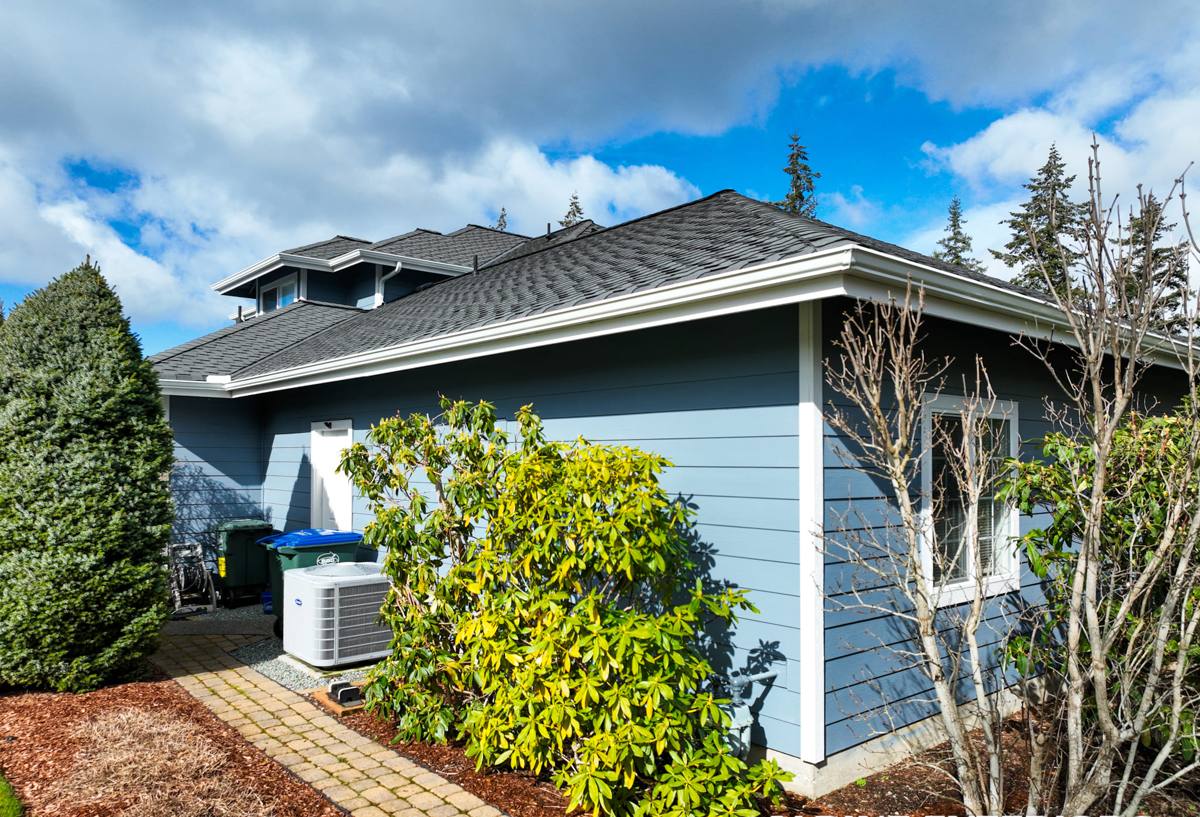
What Salt Air and Coastal Moisture Actually Do to a Roof
Salt air doesn't rot wood or crack shingles by itself, but it accelerates almost everything else that does. A few mechanisms worth understanding:
Metal fasteners and flashing corrode faster
Nail heads, flashing seams, vent boots with metal collars, and gutter hardware all corrode faster near the water than they would further inland. Once a fastener starts to rust, it loses its grip on the material it's holding down, and that's often where a leak starts — not through the shingle itself, but around the metal that's supposed to be sealing it.
Constant dampness feeds moss and algae
Driving rain keeps roof surfaces wet longer, and shaded, north-facing slopes in particular can stay damp for days after a storm passes. That moisture is exactly what moss and algae need to take hold. Once established, moss roots work into shingle granules and seams, lifting edges and holding water against the roof deck instead of letting it shed.
Freeze-thaw cycles open small problems into big ones
Whatcom County doesn't get brutal winters, but it gets enough freeze-thaw swings that any water already trapped under lifted shingles or around failed flashing can expand, crack sealant, and widen the path for the next rain to get further in.
Signs a Fairhaven Roof Needs Repair Now, Not Later
Most roof problems give warning signs well before they become a ceiling stain. Homeowners who catch these early spend far less than those who wait for an active leak:
- Moss visible on the roof surface, especially in a solid mat rather than a few scattered patches
- Granules collecting in gutters or at the base of downspouts
- Shingles that look cupped, curled at the edges, or darker in patches than the rest of the roof
- Rust streaks below metal flashing, vent boots, or valleys
- Soft or spongy spots when walked on carefully by a professional
- Daylight visible through the roof deck from inside the attic
- Water stains on interior ceilings, especially near chimneys, skylights, or where two roof planes meet
- Sagging in the roofline that wasn't there a year or two ago
Any one of these on its own might be minor. Two or three together usually mean water has already found a way past the surface layer.
What a Correct Roof Repair Actually Involves
A repair that actually holds up in this climate goes further than sealing the spot where water is showing up inside the house. Water rarely enters where it exits — it travels along the underlayment or roof deck before finding a gap to drip through, so the visible stain and the actual failure point can be several feet apart.
A repair done right typically includes:
- Finding the real entry point — not just the symptom, by tracing water path along the deck and framing where accessible.
- Removing damaged material back to sound roofing, not just covering over a compromised area.
- Checking the roof deck underneath for soft or rotted sheathing, which has to be replaced before anything goes back on top of it.
- Replacing flashing around penetrations (chimneys, vents, skylights) rather than just re-sealing old flashing with caulk, which is a short-term fix at best.
- Matching materials as closely as possible so the repaired section weathers at a similar rate to the surrounding roof.
- Addressing the cause — if moss or poor drainage contributed to the failure, that gets handled too, not just the hole it left behind.
Repair vs. Replacement: How We Decide
Not every roof problem in Fairhaven needs a full replacement, and not every leak can be reasonably patched. The honest answer depends on the roof's age, how widespread the damage is, and what's happening underneath the surface. Here's how we typically think about it:
| Factor | Repair Usually Makes Sense | Replacement Usually Makes Sense |
|---|---|---|
| Roof age | Roof is well within its expected service life | Roof is at or past the end of its typical lifespan |
| Extent of damage | Damage is localized to one area or slope | Moss, granule loss, or curling is spread across most of the roof |
| Roof deck condition | Deck underneath is sound | Rot or soft spots are found in multiple areas |
| Number of past repairs | This is a first or isolated repair | Same areas have needed repeated patching |
| Underlayment condition | Underlayment is intact where accessible | Underlayment is failing or was never properly installed |
We'll tell you plainly which category a roof falls into. There's no benefit to us talking a homeowner into a full replacement they don't need, and no benefit to patching a roof that's genuinely done.
Our Process for a Fairhaven Roof Repair
Inspection and honest diagnosis
We start on the roof and in the attic if accessible, tracing the actual path water is taking rather than assuming the leak is directly above the stain. We'll also check overall roof condition — moss coverage, flashing condition, granule loss — so you know if this repair is likely to be the only one you need for a while, or a sign of bigger issues coming.
A clear explanation before any work starts
You'll know what failed, why, what the repair involves, and a realistic cost range before we do anything. No surprise add-ons discovered halfway through unless we find something genuinely hidden from view, like deck rot that wasn't visible until we opened up the area.
The repair itself
Damaged material removed, deck checked and replaced where needed, flashing redone rather than just resealed, and new material matched to the existing roof as closely as the product line allows.
Cleanup and a look at the whole roof
We don't leave debris, old material, or fasteners on the ground or in gutters. If we notice something else developing elsewhere on the roof during the repair, we'll point it out — not to upsell, but because it's the kind of thing that's cheap to flag now and expensive to discover later.
Materials and Methods That Hold Up Near the Water
For coastal-exposed homes like those in Fairhaven, we lean toward flashing and fasteners rated for corrosion resistance rather than the cheapest standard option, since the cost difference is modest compared to redoing the same repair in a few years. On moss-prone slopes, we'll discuss zinc or copper strip treatments as a preventive measure — they discourage regrowth without requiring harsh chemical treatment of the whole roof.
We're generally cautious about roofing products with complicated multi-layer sealant systems that depend on perfect field installation to perform as advertised. Our standard is to use materials whose long-term performance we can stand behind and whose repair-ability holds up — a roofing system is only as good as how well it can be fixed later, and some newer proprietary systems make future repairs more difficult and more expensive than they need to be. That's a trade-off worth knowing about before it's on your roof, not after.
Between Repairs: What Actually Helps a Fairhaven Roof Last
A repair fixes what's already failed. A little upkeep in between keeps the next repair further off:
- Keep gutters and downspouts clear so water isn't backing up under roof edges
- Trim back branches that keep a section of roof shaded and damp longer than the rest
- Have moss addressed while it's a light coating, not after it's a thick mat
- Walk the attic occasionally (or have us do it) to catch daylight, staining, or damp insulation early
- Don't ignore small granule loss in the gutters — it's often the first visible sign of wear
None of this replaces a proper inspection every so often, especially after a hard winter storm season, but it does reduce how often you need one.
Why a Crew That Already Works Fairhaven Matters
Roofing crews who mostly work drier, inland areas of Whatcom County don't always account for how much faster moss returns or how much more aggressively flashing corrodes near the water. That's not a knock on their general skill — it's just a different set of conditions than what they see day to day. A crew that regularly repairs roofs in Fairhaven and similar waterfront-adjacent neighborhoods knows which flashing details tend to fail first in this exposure, which slopes hold moss longest, and which repairs are worth doing thoroughly versus which shortcuts simply don't hold up here.
That familiarity shows up in fewer callbacks, not in a different sales pitch. It's the difference between a repair that's still doing its job three winters from now and one that needs revisiting after the first hard rain.
If you're seeing moss, a stain on the ceiling, or just want an honest opinion on a roof's condition before it becomes an emergency, we're happy to take a look. Fill out the form below for a free, no-pressure estimate — we'll tell you what we actually see, not just what's easiest to sell.