 Sudden Valley Siding
 Building Custom Decks for Edgemoor's Bayfront Climate
Edgemoor sits close enough to the water that salt air, wind-driven rain, and shade from mature trees are part of daily life for most homes in the neighborhood, not just the ones with a direct view. We're based out of Sudden Valley and work this stretch of Whatcom County regularly, and a deck built here has to answer to different conditions than one going up on a dry, sheltered inland lot. A deck is one of the more exposed structures on a property — it takes sun, rain, and moisture from both above and below, on a wood or composite surface that homeowners walk on barefoot and expect to last for decades. Getting it right in a bayfront neighborhood like Edgemoor means paying attention to details that would matter less somewhere drier.
This page is about one thing: custom deck building and replacement for Edgemoor homes, done with an eye toward what actually holds up this close to the bay. We also handle siding, roofing, and windows, and we treat a deck as part of the same exterior envelope as the rest of the house — the framing, flashing, and fasteners all have to work together, or moisture finds the weak point eventually.
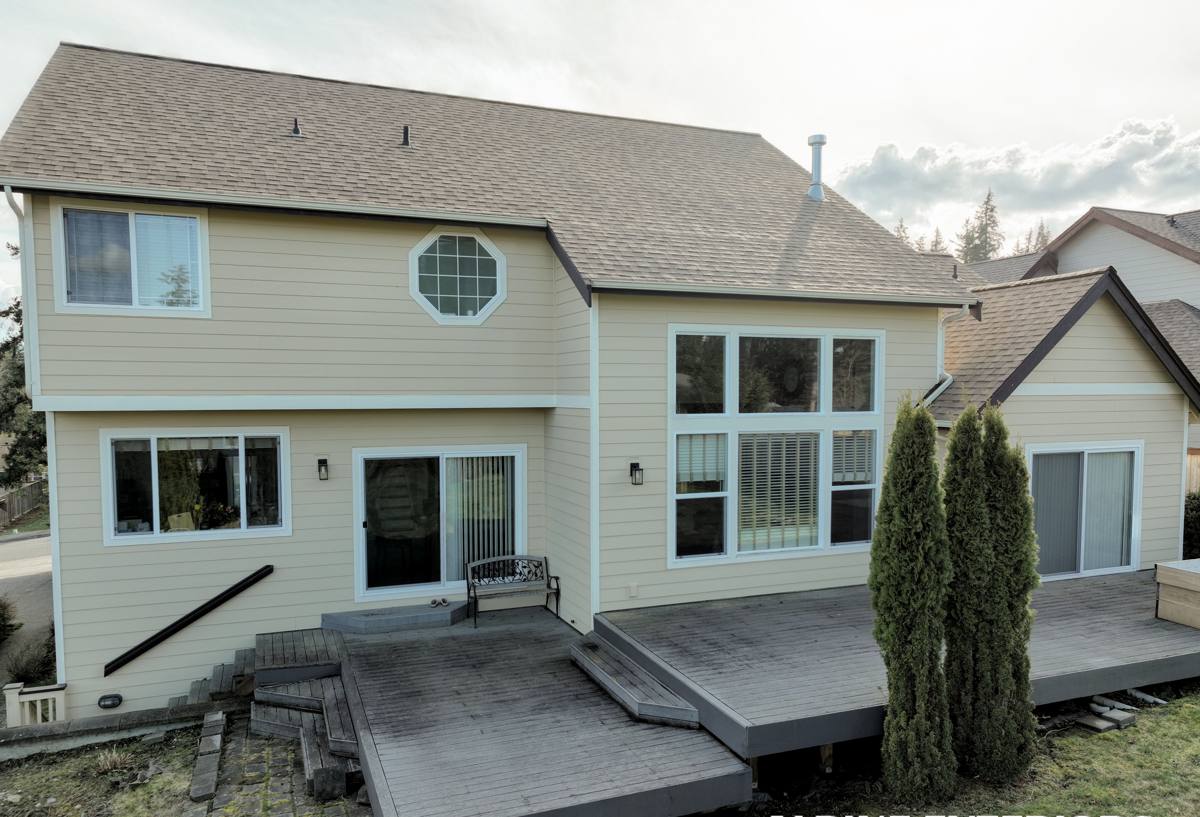
What Bayfront Conditions Do to a Deck
Salt Air and Corrosion
Homes near Bellingham Bay pick up a steady dose of salt-laden air, and that air is hard on anything metal. Fasteners, joist hangers, post bases, and railing hardware all corrode faster here than they would on an inland lot, and once a fastener starts rusting, it loses holding strength long before the rust becomes visible from the surface. A deck built with the wrong hardware can look fine for a few years and then start failing at the connections — exactly the places you don't want a surprise.
Driving Rain and Trapped Moisture
Storms coming off the water don't fall straight down; wind pushes rain sideways into ledger connections, under railing posts, and into any gap where two deck boards or framing members meet. That sideways-driven moisture is harder to keep out than a simple downpour, and it's the main reason ledger flashing and proper board spacing matter more here than in a calm, dry climate. Water that gets behind a ledger board or pools against untreated framing doesn't dry out quickly in this climate — it sits.
A Long Moss and Algae Season
Mild temperatures and near-constant moisture add up to a moss and algae season that can run most of the year on shaded or north-facing surfaces, and Edgemoor's tree cover makes this worse on plenty of lots. Moss holds moisture against a deck surface, and a slick, algae-covered deck board is also a slip hazard, not just a cosmetic problem. Any decking material with surface texture or porosity becomes a growth surface over time if it doesn't get some sun or airflow.
Choosing the Right Decking Material for This Climate
There's no single correct material for every deck, but in a bayfront neighborhood like Edgemoor, moisture behavior and maintenance tolerance should drive the decision more than upfront cost alone. Here's how the common options actually compare in this climate:
| Material | Moisture Behavior Here | Maintenance Needed | Typical Lifespan |
|---|---|---|---|
| Pressure-treated pine | Prone to checking, cupping, and splintering as it cycles wet-dry near the bay | Annual cleaning, re-staining or sealing every 1–3 years | 10–15 years before major repair |
| Cedar | Naturally rot-resistant but surface graying and moss growth come faster in constant shade and moisture | Cleaning and sealing every 1–2 years to hold color and resist moss | 15–20 years with consistent upkeep |
| Composite decking | Doesn't absorb water or rot, but needs periodic cleaning where moss and algae can still grow on the surface film | Occasional washing; no staining or sealing | 25+ years, backed by manufacturer warranty |
| Tropical hardwoods (e.g. ipe) | Very dense and naturally water-resistant, but expensive and unforgiving of installation shortcuts | Periodic oiling if a fresh look is wanted; otherwise low | 25+ years |
We'll walk through these trade-offs honestly for your specific lot — how much shade it gets, how exposed it is to wind off the water, and how much maintenance you actually want to keep up with. A homeowner who wants to spray it off once a year and forget about it needs a different answer than one who likes the look and feel of real wood and doesn't mind sealing it on a schedule.
What a Correctly Built Deck Involves
A deck that holds up in Edgemoor's climate comes down to details most people never see once it's finished. A few we won't skip:
- Proper ledger board flashing: The connection where a deck attaches to the house is the single most common source of hidden rot if it isn't flashed correctly to shed water away from the wall assembly.
- Corrosion-resistant fasteners and hardware: Stainless steel or heavy hot-dip galvanized hardware, rated for coastal exposure, at every structural connection — not just the visible ones.
- Joist tape on framing members: A protective barrier over the tops of joists and beams keeps standing water from soaking into cut lumber, which is where rot typically starts.
- Adequate board spacing and airflow underneath: Gaps sized to let water drain and air move, so boards dry out between rain events instead of staying saturated.
- Footings sized for the actual soil and slope: Many Edgemoor lots have grade changes toward the water, and footings need to account for that rather than using a generic layout.
- Guardrail and stair details that meet current code: Height, baluster spacing, and graspable handrail requirements aren't optional, especially on an elevated deck.
Permits are typically required for new decks and major rebuilds in this area, and inspections exist for a reason — they catch structural issues before they're buried under decking boards. We handle the permitting and inspection process as part of the job rather than leaving it for the homeowner to sort out.
Railings, Fasteners, and Hardware That Hold Up Near the Water
Railings take a lot of abuse on a bayfront deck — sun, salt spray, and constant handling all wear on the finish and the hardware underneath. Wood railings need the same sealing schedule as wood decking, and any metal components, from post connectors to cable rail hardware, should be rated for coastal or marine-grade exposure. Aluminum and stainless cable rail systems tend to do well here because they resist corrosion and don't need refinishing, but the fasteners holding them to the structure still matter — a beautiful railing on undersized or the wrong-grade hardware is a problem waiting to show up in a few years, usually right at the connections that take the most stress.
Our Process, Start to Finish
- On-site consultation: We look at your lot, the sun and shade pattern, wind exposure, existing structure if there is one, and what you actually want to use the space for.
- Design and material selection: We walk through decking, railing, and framing options with honest trade-offs on maintenance, cost, and how each holds up in this climate.
- Permitting: We handle the permit application and any engineering documentation the project requires before work starts.
- Framing and structural work: Footings, ledger attachment, joists, and beams go in first, built to the loads and spans the design calls for.
- Decking, railing, and finish work: Surface material and railings go on last, with attention to spacing, fastener placement, and finish details.
- Final walkthrough and inspection: We confirm everything passes inspection and walk the finished deck with you before calling the job done.
Signs Your Current Deck Needs Attention
A lot of deck problems in this climate develop underneath or behind the surface, well before they're obvious from the top. Worth checking for:
- Soft, spongy, or bouncy spots underfoot, especially near the house or stair landing
- Rust staining around fasteners, joist hangers, or railing posts
- Gaps or dark staining where the deck meets the house at the ledger board
- Wobbly railing posts or any give when you lean on the railing
- Persistent moss, algae, or a slick green film that comes back quickly after cleaning
- Boards that have cupped, split, or pulled away from their fasteners
- Standing water that doesn't drain within a day of a rain event
Any one of these is worth a look before it's ignored through another wet season. Some are cosmetic; some point to structural issues that get more expensive the longer they sit.
Maintenance: What Edgemoor Homeowners Should Expect
Even a well-built deck needs some upkeep in this climate — the difference between materials is how much and how often, not whether maintenance is needed at all. Wood decks benefit from an annual cleaning to knock back moss and algae before it embeds in the grain, plus resealing on a schedule that depends on sun exposure and species. Composite decking needs far less — periodic washing to keep the surface film from becoming a growth surface — but it isn't fully maintenance-free near the water. Hardware and railings are worth a visual check each year regardless of decking material, since that's where corrosion shows up first and is cheapest to address early.
Why a Local Crew That Already Works Edgemoor Matters
A crew that builds decks across Whatcom County's bayfront neighborhoods regularly has seen how salt air, driving rain, and moss actually affect a deck over years, not just how a material performs on a spec sheet. That experience shapes real decisions on build day — where extra flashing attention pays off, which lots need footings adjusted for slope toward the water, and which hardware grade is worth the extra cost so a homeowner isn't dealing with a rot repair or a wobbly railing a few years in. Edgemoor's bayfront exposure isn't the same as a sheltered inland lot even a few miles away, and building accordingly, rather than applying a generic approach, is what keeps a deck solid for the long haul.
If you're planning a new deck, replacing an aging one, or just want an honest look at what shape yours is in, we're glad to come take a look. Reach out using the form below to schedule a free, no-pressure estimate.