 Sudden Valley Siding
 Why Decks in Columbia Take a Different Kind of Beating
The Columbia area sits inside Sudden Valley's forested bowl around Lake Whatcom, and that setting is a mixed blessing for deck owners. The tree cover that makes these lots private also keeps decks shaded and slow to dry. Add in the marine-influenced air that moves through Whatcom County off the Sound, a rainy season that runs long by any standard, and a moss cycle that can stretch from early fall into late spring, and you get a climate that is genuinely harder on exterior wood structures than a drier inland town would see. Decks here don't fail because of one big storm. They fail slowly, from cumulative moisture that never fully evaporates between rain events.
That slow failure is the tricky part. A deck can look perfectly serviceable from the top — boards look solid, the finish looks okay — while the framing underneath, or the ledger connection to the house, has been quietly softening for a couple of seasons. We've based our repair approach around catching that gap before it becomes a safety issue rather than a cosmetic one.
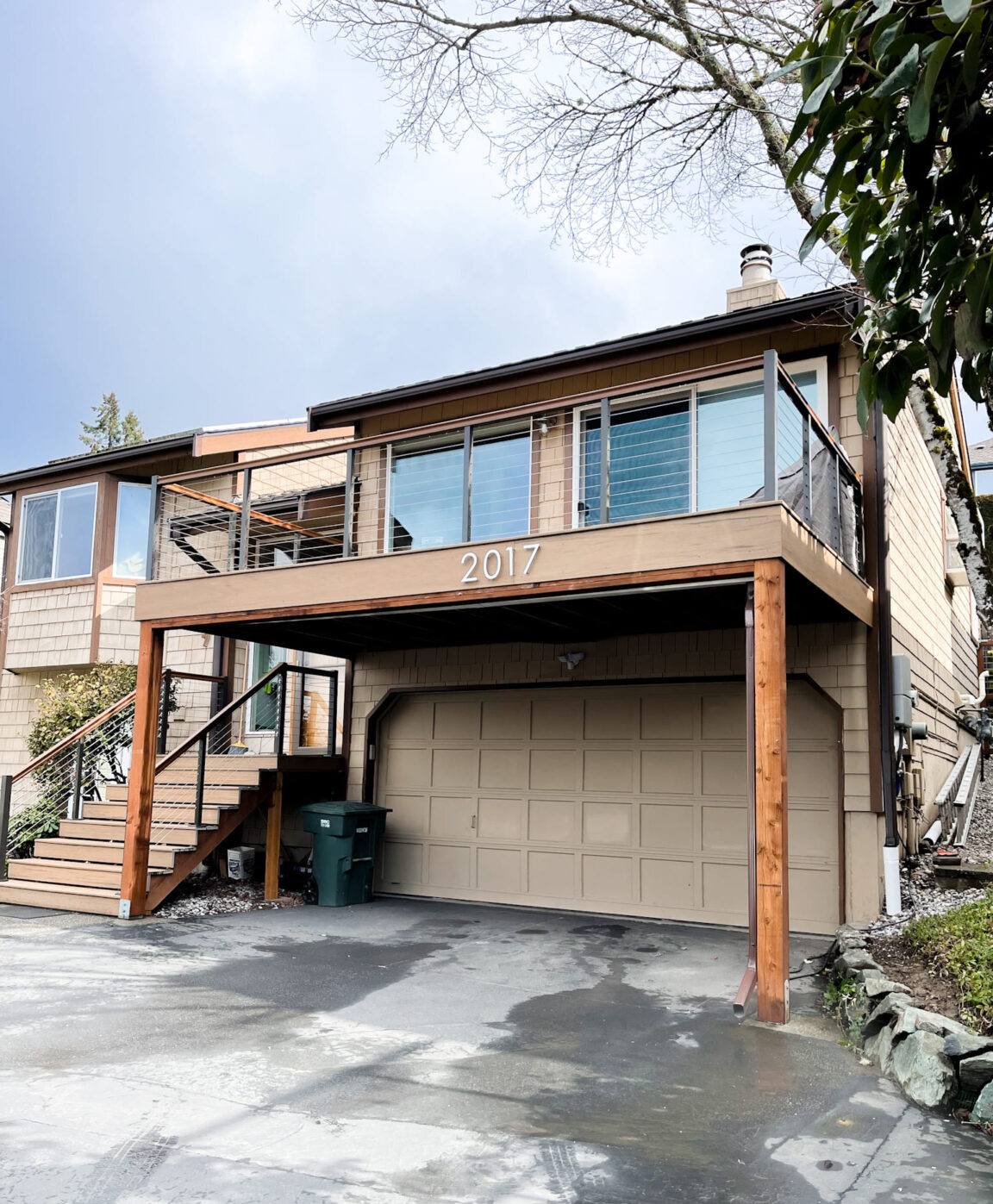
Common Deck Problems We Find on Columbia Properties
Framing and Structural Connections
The single most common hidden failure point on decks in this climate is the ledger board — the framing member bolted to the house that carries much of the deck's structural load. Water works its way behind poorly lapped flashing (or through old nail penetrations) and, because the area doesn't get the sun exposure to dry things out quickly, that moisture sits against the rim joist and ledger for weeks at a time. We also regularly find deck posts set directly on or too close to grade, concrete piers that have shifted or settled on sloped lots, and fasteners that have corroded well ahead of schedule after years of chronic dampness.
Surface Boards and Guardrails
On the visible surface, the giveaways are board cupping, splitting along the grain, and moss or algae staining that makes the deck surface slick underfoot for a good chunk of the year. Guardrail posts often loosen not because the rail itself failed but because the framing member it's lagged into has softened. Stair stringers are another weak point, especially where the bottom of the stringer sits close to soil or mulch and stays damp longer than the rest of the structure.
Fastener and Hardware Corrosion
Older decks — even ones built with treated lumber — were often assembled with fasteners and joist hangers that weren't rated for the corrosive combination of treated wood chemicals and constant moisture. Over time these fasteners lose holding strength well before the wood around them looks obviously bad. It's one of the more common reasons a deck feels slightly "bouncy" or a railing has developed play even though nothing looks visibly broken.
Repair vs. Replace: How We Make the Call
Not every issue we find means a full rebuild, and we don't default to recommending the most expensive fix. The decision usually comes down to how much of the structure is affected versus the surface, and how old the deck is relative to its expected service life in this climate.
| Factor | Usually points to repair | Usually points to replacement |
|---|---|---|
| Extent of rot | Isolated to a few boards, one post, or one section of ledger | Widespread soft framing across multiple joists or the full ledger run |
| Deck age | Under 12–15 years, built to a reasonable original spec | Original construction is old, undersized, or missing modern hardware entirely |
| Connections | Hardware and fasteners are sound; only wood needs attention | Fasteners are broadly corroded or hardware was never installed correctly |
| Cost ratio | Repair cost is a fraction of what a rebuild would run | Repair scope keeps growing and approaches rebuild cost anyway |
When a deck falls in the middle — sound framing but tired decking, or a solid frame with one problem post — repair is almost always the honest recommendation. When the ledger connection itself is compromised or rot has spread through the substructure, patching individual boards just delays a bigger problem and can mask a genuine safety concern.
What a Correct Deck Repair Actually Involves
Inspection Before Anything Gets Removed
A proper repair starts with probing, not guessing. We check framing members with an awl or screwdriver at the ledger, post bases, and joist ends — sound wood resists the tool, rotted wood gives way easily. We also pull back flashing where accessible to see how water has actually been moving through the connection, rather than assuming based on the surface alone.
Removing Only What's Actually Compromised
Good repair work replaces the wood and hardware that failed, not everything within reach. That means matching dimensional lumber, using structural screws or bolts rated for the connection (not general-purpose deck screws), and installing proper joist hangers and post bases rather than toe-nailing a replacement into place because it's faster.
Flashing Done the Way It Should Have Been Done Originally
Ledger flashing is where we see the most corner-cutting on older decks, and it's also where correcting the detail matters most in a climate like this one. We install self-adhering flashing membrane in proper shingle-lap order — house wrap or siding over the top flange, flashing over the ledger, and a drip edge directing water away from the band joist — so water sheds away from the house instead of pooling against it.
Bringing Safety Items Up to Current Standards
If a repair touches a guardrail or stair, we check rail height, baluster spacing, and stair rise-and-run against current code even when the rest of the deck is being left alone. It's not always required for a repair-only scope, but if we're already opening up that section, there's no reason to put it back the same way if it was under-built to begin with.
Decking Material Considerations for a Damp, Shaded Lot
Material choice matters more on a shaded, moisture-heavy lot than it does on an open, sunny one, and there isn't a single right answer for every Columbia property.
| Material | Strength in this climate | Trade-off to plan for |
|---|---|---|
| Cedar | Naturally moisture- and insect-resistant; ages well visually in a wooded setting | Needs periodic cleaning and sealing to keep shedding water; individual boards are easy to replace later |
| Pressure-treated lumber | Cost-effective, structurally proven, widely available for exact matching repairs | Requires regular maintenance and can still trap moisture at fastener points if not sealed |
| Composite decking | Low surface maintenance, resists splintering and staining better than wood | Hidden framing underneath still needs to be wood and still needs the same moisture protection; matching an older discontinued composite line can be difficult |
Our standard is to match the material to the site conditions and the homeowner's appetite for upkeep, not to push whatever is easiest to install. A shaded, low-airflow deck that never fully dries out is a poor candidate for a low-end composite that isn't rated for constant moisture contact, just as it's a poor candidate for untreated wood with no maintenance plan behind it.
Our Process When You Call
- A site visit where we physically inspect the framing, not just look at the surface from a distance.
- A written scope that separates what's structurally compromised from what's cosmetic, so you know exactly what you're paying to fix.
- The repair itself, done with correct fasteners, hardware, and flashing rather than the fastest patch available.
- Cleanup and haul-away of old material — you shouldn't be left with a pile of rotted lumber to deal with.
- A final walk-through so you can see and understand what was done and why.
Deck Maintenance Checklist for Whatcom County's Wet Season
A few habits go a long way toward stretching the life of a deck in this climate and catching small problems before they become structural ones.
- Clear leaves, needles, and debris from between boards regularly — trapped organic matter holds moisture against the wood.
- Check the ledger flashing line once a year for gaps, cracking, or signs of water tracking down the siding.
- Look under the deck for standing water around post bases after a heavy rain.
- Reseal or restain wood decking on the schedule the product calls for — don't wait until it's visibly gray and dry.
- Clean moss and algae with an appropriate deck cleaner rather than a pressure washer alone, which can drive water into the wood grain.
- Inspect visible hardware — joist hangers, post caps, guardrail brackets — for rust or looseness.
- Trim back branches and vegetation that keep sections of the deck in constant shade and slow drying time.
Why a Crew That Already Works Columbia Matters
Decks in this part of Sudden Valley share a lot in common — similar age ranges, similar exposure to lake-effect moisture and tree cover, similar hillside lot layouts that affect how a crew gets material and equipment to the work area. A crew that's already worked in the neighborhood has seen these patterns enough times to know where to look first, which saves you money on the inspection phase and reduces the chance of a repair scope growing mid-project because something was missed. Local familiarity also helps with practical logistics — narrow or steep driveways, limited staging space, and Whatcom County's permitting expectations for structural repair work — so the job moves efficiently instead of hitting avoidable delays.
If you're dealing with a soft spot on your deck, a railing that's developed play, or you just want an honest read on how much life is left in the structure, we're happy to take a look. Request a free, no-pressure estimate using the form below and we'll give you a straight answer on what's actually needed.