 Sudden Valley Siding
 Why Cordata Homes Need Windows Built for Whatcom County Weather
Cordata sits inside the same weather pattern that shapes exterior work all over Whatcom County: long stretches of wet, gray months, wind-driven rain that comes in sideways off the water, salt-tinged air drifting inland from Bellingham Bay, and a moss season that can run from fall through spring on shaded lots. None of that is dramatic on its own, but it adds up fast around window openings. A window is the weakest point in any exterior wall — it's a hole cut through the siding, the weather-resistive barrier, and often the framing itself. If it isn't flashed and sealed correctly, it becomes the path water uses to get into the wall cavity.
We see this pattern often enough on the exterior side of siding jobs: siding that looks fine but hides rot at the corners of a window because the original install skipped a sill pan or lapped the flashing backwards. Cordata's tree cover and the general dampness of Whatcom County make this worse over time, not better — moss and algae hold moisture against surfaces longer, and a window that leaks a little in year one is often leaking a lot by year five.
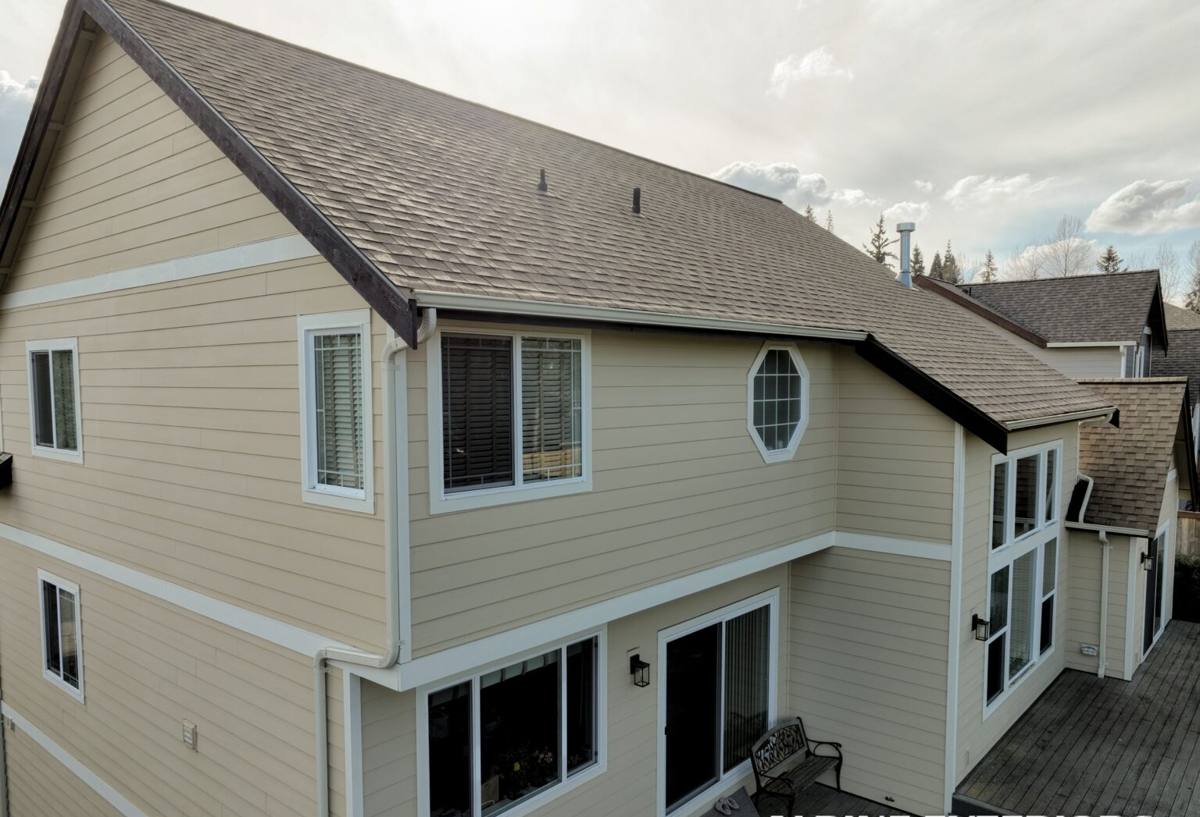
What "Custom" Actually Means for a Window Job
"Custom windows" doesn't have to mean unusual shapes or high-end architecture, though we do that too. Most of what we build custom is simple: an exact fit. Homes in this area were built across a lot of different decades, and rough openings drift over time as houses settle. Stock window sizes rarely match a real opening perfectly, which is why so many replacement jobs end up with gaps packed full of extra trim, foam, or caulk trying to make up the difference.
A properly custom window is manufactured to the actual measured opening — including any out-of-square correction — so the installer isn't fighting the gap after the fact. That matters more here than in a dry climate, because every one of those gap-filling shortcuts is a spot where wind-driven rain can find its way in.
Where Custom Sizing Comes Up Most
- Older Cordata homes with original wood windows and non-standard rough openings
- Additions or remodels where the opening doesn't match a modern stock size
- Bay, garden, or specialty shapes that need to match existing trim lines
- Replacing one odd window in a run of otherwise-standard windows, where mismatched sightlines would look wrong
The Parts of the Job That Actually Determine Whether It Leaks
Flashing and the Water Path
Every window opening needs a sill pan or sloped sill flashing so any water that gets past the window sheds back outside instead of sitting on the framing. Side and head flashing need to lap correctly with the house's weather-resistive barrier — over the WRB at the top, under it at the sides and bottom — so water always drains down and out, never in. This is the step that gets rushed on cheap jobs, and it's invisible once the trim goes back on. It's also the single biggest factor in whether a window job lasts 10 years or 30.
Full-Frame vs. Insert Replacement
An insert (or "pocket") replacement drops a new window into the old frame and is faster and less invasive, but it only works if the existing frame and flashing are still sound. A full-frame replacement removes the old unit down to the rough opening, lets us inspect and repair any hidden rot, and lets us install fresh flashing from scratch. On a lot of Cordata homes — especially ones with visible staining, soft trim, or moss buildup around the windows — full-frame is the honest recommendation even though it costs more, because an insert job installed over a damaged frame just seals the problem in rather than fixing it.
Matching Trim and Exterior Finish
Because we do siding work day to day, we treat the window and the siding around it as one system, not two separate jobs. Trim width, reveal, and finish get matched to the house so the new windows don't look bolted on, and the siding-to-window transition gets re-caulked and detailed properly rather than just patched around.
Material and Glass Options
There's no single "best" window material — the right call depends on the house, the budget, and how much upkeep you want to take on. Here's how the common options actually compare for a wet, moderate coastal climate like this one:
| Material | Moisture Behavior | Maintenance | Typical Lifespan |
|---|---|---|---|
| Vinyl | Won't rot; expands/contracts with temperature swings | Low — no painting, occasional cleaning | 20–30 years |
| Fiberglass | Very stable in wet/dry cycling, minimal expansion | Low | 30–40+ years |
| Wood-clad | Good if the cladding and flashing are done right; wood interior needs a dry envelope | Moderate — exterior clad is low-upkeep, interior wood needs occasional attention | 20–30+ years with proper install |
We install vinyl and fiberglass most often on Cordata jobs because they hold up well against the constant damp-dry cycling this climate puts windows through, and they don't rely on a paint film to stay protected from moisture. Wood-clad windows can absolutely work here and look great, but they're less forgiving of installation mistakes — if the cladding or flashing is off even slightly, moisture has an easier path to the wood underneath. We'll walk through the honest trade-offs for your specific house rather than push one product line.
Energy Performance in a Mild, Wet Climate
Whatcom County doesn't hit the temperature extremes that drive window shopping in a lot of the country, but two numbers still matter here. U-factor measures how well the window resists heat loss — lower is better for keeping heating bills down through our long cool season. Solar heat gain coefficient (SHGC) matters less here than in sunnier climates, but a moderate SHGC still helps on the handful of bright days we do get. Just as important in a climate this humid: proper glass selection and installation reduce interior condensation, which is what actually causes the fogged-up, drippy windows a lot of older Cordata homes deal with every winter. A well-sealed, properly flashed window with a decent U-factor rating solves that condensation problem far more reliably than a space heater or a dehumidifier.
Our Process, Start to Finish
- On-site assessment — we measure every opening individually and check the condition of the existing frame, sill, and siding around it.
- Honest scope — we tell you upfront whether insert or full-frame replacement makes sense for each window, and why.
- Custom order — units are built to the exact measured opening, not rounded to the nearest stock size.
- Removal and inspection — old windows come out carefully so we can see the framing underneath before anything new goes in.
- Flashing and install — sill pan, side and head flashing, and sealant go in following a consistent water-management sequence, every time.
- Trim and siding tie-in — exterior trim and siding are re-detailed so the finished look matches the rest of the house.
- Walkthrough and cleanup — we check operation, sealing, and appearance with you before we call it done.
Signs Your Cordata Home's Windows Need Attention Now
- Soft, spongy, or discolored trim or siding around a window frame
- Persistent moss or dark streaking below a window sill
- Fogging or moisture between double-pane glass (a failed seal)
- Drafts you can feel even with the window fully latched
- Windows that are hard to open, close, or lock — often a sign the frame has shifted
- Paint or finish that's bubbling or peeling near the window edges
Any one of these on its own isn't an emergency, but they're worth having looked at before the next wet season, since water damage around a window opening tends to spread into the wall framing quietly, well before it shows up as a visible problem indoors.
Why Hire a Crew That Already Works in Cordata
A window installer who works Whatcom County regularly knows how this climate treats a house differently than one who mostly works drier markets. We know to check for moss-driven moisture retention on north- and shade-facing walls, we know how salt-tinged air near the bay can accelerate wear on certain hardware and finishes, and we know that a flashing detail that's "good enough" in a mild dry climate isn't good enough here. Because window work and siding work are part of the same exterior envelope, having one crew handle both means there's no finger-pointing later about whose scope a leak fell into — we're accountable for the whole assembly, not just the window itself.
If you're weighing whether it's time to replace a window, repair damage around one, or plan a custom fit for an odd opening, we're happy to take a look and give you a straight answer — including telling you when a window doesn't need full replacement yet. Reach out for a free, no-pressure estimate using the form below.