 Sudden Valley Siding
 Why Alger Homes Need Windows Built for This Specific Climate
Alger sits in the stretch of Whatcom County where marine weather off the Salish Sea meets the wetter inland air pushing down from the foothills. That combination means homes here deal with more than just "rain" in the generic sense. You get long stretches of driving, wind-blown rain that hits windows sideways rather than straight down, salt-laden air working its way inland on stronger weather systems, and a moss and mildew season that can stretch from fall through spring. Any one of these on its own is manageable. Together, over years, they expose the weak points in older or poorly installed windows fast.
Energy efficiency and weather resistance are really the same conversation out here. A window that leaks air is almost always a window that's also vulnerable to moisture intrusion, and a window that's letting in moisture is going to lose its insulating value long before its glass or frame "wears out" on paper. When we talk about energy-efficient windows for an Alger home, we're talking about the whole assembly — glass, frame, flashing, and sealant — working together to keep both heat and water where they belong.
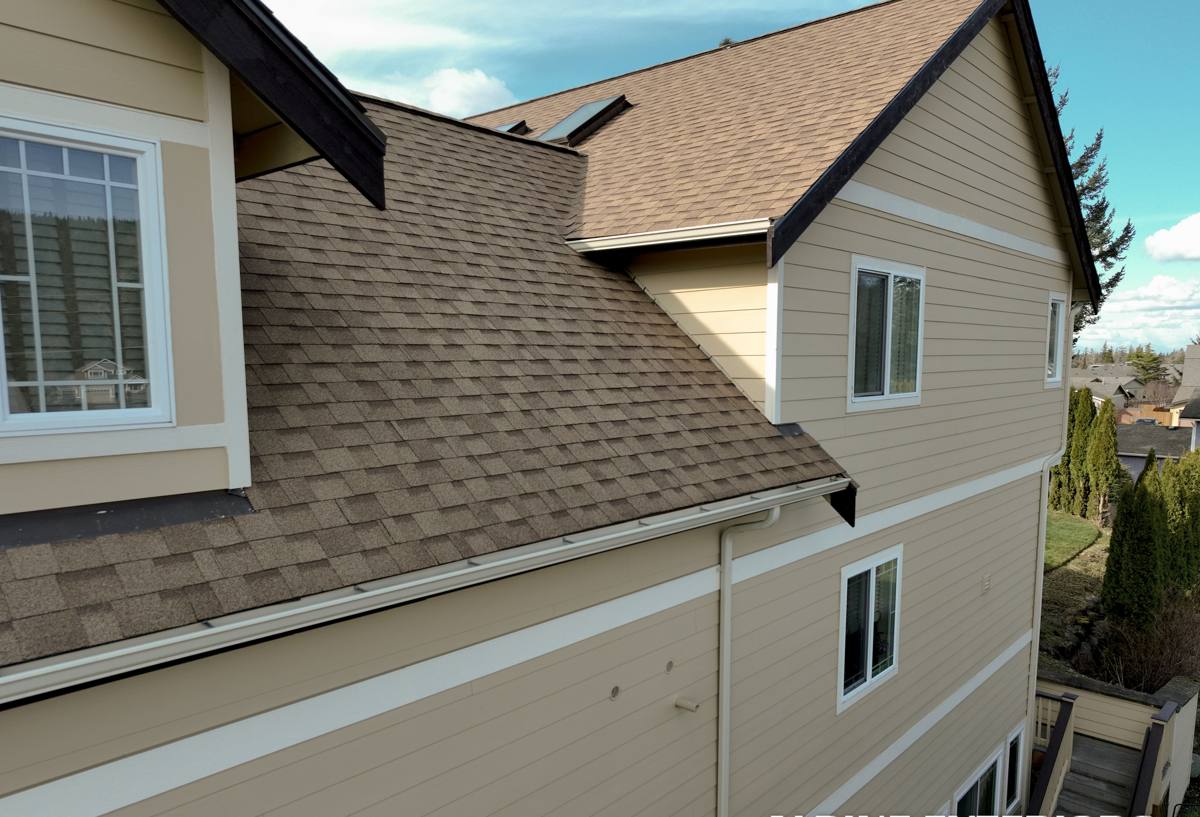
What "Energy-Efficient" Actually Means for a Whatcom County Home
Energy-efficient windows aren't just "double-pane" or "has a sticker on it." A handful of specs actually matter for a house in this climate, and they're worth knowing before you talk to anyone about a quote:
- U-factor — measures how well the window resists heat loss. Lower is better. This is the single most relevant number for our winters.
- Solar Heat Gain Coefficient (SHGC) — how much solar heat passes through the glass. Matters more on south- and west-facing walls that get direct sun in summer.
- Air leakage rating — a lower number means less uncontrolled air movement through the sash and frame joints, which is where driving rain also finds its way in.
- Condensation resistance — directly tied to how well a window handles the humidity swings typical of a marine climate.
Gas-filled (usually argon) double- or triple-pane glass with a low-E coating is the standard building block for meeting these numbers in our region. Triple-pane adds cost and weight and is worth it on some north-facing or particularly exposed walls, but it isn't automatically the right call for every opening on every house — that's a judgment call we make room by room, not a blanket upsell.
Frame Material Matters as Much as the Glass
A high-performance glass package installed in a frame that isn't suited to constant moisture exposure will underperform within a few years. This is the part of the conversation that gets skipped when window shopping turns into a pure price comparison.
| Frame Material | How It Handles Our Climate | Maintenance | Typical Fit |
|---|---|---|---|
| Vinyl | Good moisture resistance, won't rot or corrode from salt air; can expand/contract with temperature swings if poorly installed | Low — occasional cleaning | Most Alger homes, best value for the performance |
| Fiberglass | Excellent dimensional stability, holds up well to sustained wet weather and temperature cycling | Low | Homes wanting longer service life, willing to pay more upfront |
| Wood-clad | Attractive, but the exposed wood core is more sensitive to prolonged moss-season dampness if the exterior cladding or sealant fails | Higher — needs monitoring at joints and sills | Homes prioritizing a specific traditional look, with owners willing to keep up on inspection |
| Aluminum | Conducts heat and cold readily, prone to condensation in our humidity unless thermally broken | Moderate | Rarely our first recommendation for residential energy efficiency here |
We're not against wood-clad or aluminum outright — there are legitimate reasons to choose either — but we'll tell you plainly what that choice means for upkeep in a driving-rain, salt-air environment before you commit, rather than let you find out the hard way in year six.
Signs Your Current Windows Are Costing You Money
Most Alger homeowners don't call us because they woke up one day wanting new windows. They call because something tipped them off. Common signs worth acting on before they get worse:
- Condensation forming between the panes (not just on the inside surface) — this means the seal has failed and the insulating gas is gone.
- A noticeable draft near the sash even when the window is fully latched.
- Soft or discolored trim or sill wood, especially on walls that face prevailing wind and rain.
- Visible moss or persistent green staining building up around the window frame or the siding directly above it.
- Rooms that are harder to heat evenly, particularly ones with older single-pane or early-generation double-pane windows.
- Difficulty opening or closing that didn't used to be there — often a sign the frame has shifted from moisture or age.
What a Correct Window Installation Actually Involves
The window unit itself is maybe half the job. The other half — the part that determines whether it performs for fifteen years or fails in three — is how it's integrated into the wall.
Flashing and Water Management
Because Alger gets wind-driven rain, not just vertical rain, flashing has to be detailed to shed water outward and downward at every layer: sill pan first, then side flashing that laps over it, then head flashing that laps over the siding above the window. Skipping or shortcutting this sequence is the single most common cause of hidden rot we find behind window trim on older homes in this area.
Air Sealing Without Trapping Moisture
The gap between the window frame and the rough opening needs to be sealed for air infiltration, but not sealed in a way that traps incidental moisture inside the wall cavity. We use sealants and backer materials suited for this, and we make sure there's still a path for any water that does get in to drain back out, rather than pocket behind the frame.
Level, Plumb, and Properly Shimmed
A window that's slightly out of square will bind, won't seal evenly against weatherstripping, and puts uneven stress on the frame over time — which shows up later as air leaks and premature seal failure, even on a good-quality unit.
Matching the Window to the Wall Assembly
Older Alger homes weren't all built with the same wall assemblies, and retrofitting energy-efficient windows into an older opening sometimes means adjusting the approach — full-frame replacement versus insert replacement — depending on the condition of the existing frame and sheathing. We check this before quoting, not after we've already opened the wall.
Our Process, Start to Finish
- On-site assessment. We look at each window opening individually — condition of the existing frame, sun exposure, wind exposure, and any visible moisture history — rather than quoting off a generic per-window price.
- Product recommendation by opening. Not every window on the house needs the same spec. We'll tell you where triple-pane or a different frame material earns its cost and where it doesn't.
- Written estimate with the reasoning behind the recommendations, not just a number.
- Removal and inspection. Once the old window is out, we check the framing and sheathing underneath for hidden moisture damage before anything new goes in.
- Installation with full flashing and air-sealing detail as described above.
- Site cleanup and walkthrough so you understand how the new windows operate and what maintenance, if any, they'll need.
Why a Crew That Already Works in Alger Matters
This isn't a sales point, it's a practical one. A crew that regularly works Whatcom County's coastal and near-coastal neighborhoods has already seen how houses in this specific area age — which sides of a house take the worst of the wind-driven rain, how fast moss builds up on north-facing trim, which older window brands and installation styles from decades past tend to fail first. That local pattern recognition shortens the assessment, and it means fewer surprises once a window is out of the wall.
It also means we're set up to actually service what we install. If a seal ever needs attention or a sill needs a look after a rough winter, we're not driving in from out of the area to do it.
Questions to Ask Before You Sign a Window Contract
- Will you flash the opening in full — sill pan, side, and head flashing — or just caulk around the new unit?
- What's the U-factor and SHGC on the specific product you're quoting, not just the brand name?
- Are you recommending full-frame replacement or insert replacement for my openings, and why?
- What happens if you find rot or moisture damage once the old window is removed?
- What's covered under warranty — glass seal failure, hardware, installation labor — and for how long?
- Will the same crew that quotes the job also install it?
Protecting the Investment After Installation
New energy-efficient windows reduce maintenance, but they don't eliminate it in this climate. A little upkeep goes a long way toward getting the full service life out of them:
- Keep gutters and downspouts clear so overflow doesn't run down onto window heads and trim.
- During moss season, check the trim and sill areas for buildup a couple of times and clean it off before it holds moisture against the wood or siding.
- Operate every window at least a few times a year, even ones you rarely open, to keep weatherstripping and hardware working properly.
- Wipe down tracks and weep holes so they can keep draining as designed — a clogged weep hole defeats the water-management system built into the frame.
If you're weighing new windows for a home in Alger, we're happy to come take a look and give you a straightforward, no-pressure estimate — including an honest read on which windows actually need replacing now versus which can wait. There's a form below to get started.