 Sudden Valley Siding
 Building New in Barkley Means Building for Whatcom County Weather
Barkley sits close enough to Bellingham Bay and the Lake Whatcom corridor that new homes here deal with a specific mix of weather stress: salt-tinged air off the Sound, long stretches of driving rain pushed in by southwesterly wind, and a moss and mildew season that can run most of the year in shaded, north-facing exposures. None of that is dramatic on any single day. It's the accumulation that matters. A window that's installed correctly will shrug off twenty years of that pattern. A window that's installed with a shortcut in the flashing or a gap in the weather-resistive barrier will start showing problems in three to five.
New-construction window installation is the one point in a home's life where getting this right is easiest and cheapest. The wall is open, the sheathing is exposed, and there's no siding, trim, or interior finish to work around. Once the house is closed in, fixing a bad window install means cutting into finished walls. That's why this stage deserves the same care whether it's one window or forty.
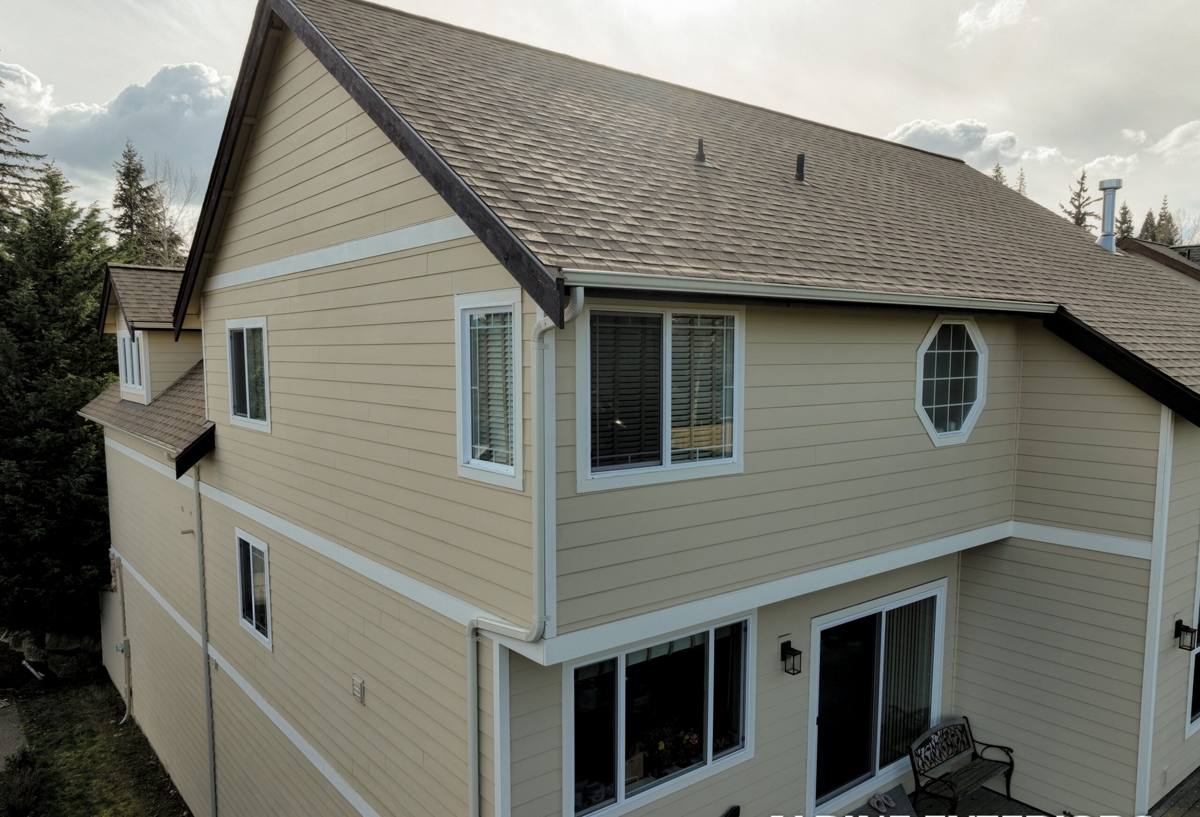
What "New-Construction" Windows Actually Means
New-construction windows are built with a nailing flange (sometimes called a nail fin) around the perimeter of the frame. That flange gets integrated directly into the wall's water management system — lapped under the house wrap or building paper above, over it on the sides and bottom — so water sheds down and out instead of behind the window into the wall cavity. This is different from a replacement or "pocket" window, which is sized to slide into an existing frame without disturbing the exterior wall.
For a new build or an addition in Barkley, nail-fin construction is almost always the right call. It gives the cleanest, most reliable moisture barrier available, and it's the standard the window manufacturers design their warranties around. The tradeoff is that it has to be installed in the correct sequence relative to the house wrap and flashing — there's no forgiving it after the siding goes on.
Why Sequence Matters More Here Than in Drier Climates
In a low-rainfall region, a minor flashing error might never get tested by enough water to show up. Whatcom County doesn't give you that margin. Wind-driven rain off the Sound will find any gap in the water-shedding layer, and it will find it repeatedly across a wet season, not just once. That's why we treat flashing sequence as non-negotiable rather than a nice-to-have.
What a Correct Installation Involves
A properly installed new-construction window in this climate follows a specific order. Skipping or reversing any of these steps is the single most common cause of window-related water damage we get called out to diagnose in homes that are only a few years old.
- Rough opening is checked for square, level, and correct dimension before the window ever arrives on site.
- Sill pan flashing is installed first, sloped slightly to the exterior, so any water that does get past the window has a path back out instead of pooling on the sill framing.
- Window is set, shimmed level and plumb, and fastened through the nailing flange per the manufacturer's schedule — not just at the corners.
- Side flashing tape goes over the flange, then head flashing goes over that, always shingle-lapped so upper layers overlap lower ones.
- House wrap is integrated back over the head flashing, maintaining the same shingle-lap principle up the wall.
- Interior gaps between the frame and rough opening are sealed with a compatible low-expansion foam or backer rod and sealant — not packed solid, which can bow the frame.
- Exterior joints get a compatible sealant bead where the window manufacturer specifies one, using a product rated for the cladding it will sit against.
Every one of those steps is inspectable before the siding goes on. That's the advantage of doing this right at the new-construction stage — and the reason we walk each opening with the builder or homeowner before it gets covered up.
Window Material and Performance Considerations
For a Barkley build, the material choice matters less for salt-air corrosion resistance than people expect — properly finished vinyl, fiberglass, and clad-wood frames all hold up fine here — but it matters a lot for moisture behavior, maintenance, and how the frame handles the freeze-thaw swings and constant damp we get through fall and winter.
| Frame Type | Moisture Behavior | Maintenance | Typical Fit |
|---|---|---|---|
| Vinyl | Won't rot or corrode; dimensionally stable in damp conditions | Low — rinse as needed | Most new-construction budgets |
| Fiberglass | Very stable across temperature and moisture swings; minimal expansion/contraction | Low | Larger openings, higher-end new builds |
| Wood, clad exterior | Exterior clad face resists weather; interior wood needs a dry wall cavity to stay protected | Moderate — depends on interior finish care | Homeowners wanting a wood interior look |
| Solid wood, unclad | Requires diligent exterior finish maintenance in this rainfall pattern | High — we generally steer new builds away from this here | Historic or period-specific projects only |
We're straightforward with builders and homeowners about that last row: an unclad wood exterior can look great, but in a climate with this much sustained rain and shaded moss growth, it puts a real ongoing maintenance burden on whoever owns the house. It's not that the product is bad — it's that it asks more of the owner than most people realize when they're picking finishes off a spec sheet. We'll install what's specified, but we'll tell you honestly what it takes to keep it looking good.
Coordinating With Builders and General Contractors
Most of our new-construction window work in the Sudden Valley and Barkley area comes in as a sub-trade on someone else's build schedule, which means timing matters as much as technique. We work directly with the GC's framing and siding crews so the window install lands at the right point — after the house wrap is on and the rough openings are finish-framed, before siding crews close things up. A poorly timed window install can hold up an entire crew behind it, and a rushed one gets covered by siding before anyone's had a chance to check the flashing.
On multi-window builds we also flag any rough-opening sizing issues back to the builder early, while they're still cheap to fix, rather than forcing a window to fit an opening that's slightly off.
What to Check Before Windows Get Covered by Siding
- Sill pan flashing is present and sloped outward, not flat or reversed
- Flashing tape is shingle-lapped correctly — head over sides, sides over sill
- House wrap is properly integrated back over the head flashing with no gaps
- Every window is shimmed level and plumb, not just tacked in at an angle
- Fasteners follow the manufacturer's nailing schedule around the full flange
- Interior perimeter gaps are sealed with an appropriate low-expansion product
- Exterior sealant joints match what the window manufacturer specifies for warranty compliance
If you're a homeowner overseeing your own build, this is a reasonable list to walk with any window crew before the siding trade starts. A contractor who's confident in their work won't mind you looking.
Why Local Experience in Barkley Specifically Matters
Whatcom County's microclimates vary more than people expect over a short distance. A lot in Barkley with exposure toward the water handles wind-driven rain differently than one tucked into tree cover a mile inland, where the concern shifts more toward shade, moisture retention, and moss buildup on north-facing walls. A crew that's worked a number of builds in this specific area has already seen how these local conditions play out on actual houses — which openings tend to take the worst weather, which details need extra attention on a shaded lot, and how the local building department likes to see flashing detailed on inspection.
That's different from general new-construction window experience. It's the difference between installing to a spec sheet and installing for the specific house, on the specific lot, in the specific weather pattern it's going to sit in for the next several decades.
Warranty and Long-Term Performance
Window manufacturers structure their product warranties around correct installation — most explicitly require nail-fin, flashed installation per their instructions, and installation defects are one of the most common reasons a warranty claim gets denied. Beyond the manufacturer's product warranty, we stand behind our own installation work separately, because the two are genuinely different things: a window can be manufactured perfectly and still fail from a bad install, or hold up fine even on a product with a shorter warranty if it's installed correctly. Ask any window contractor to be clear about which warranty covers what before work starts — it's a fair question and a good contractor will have a straight answer.
Getting Started
If you're building new or adding on in Barkley or elsewhere around Sudden Valley, we're happy to walk your plans, talk through window and material options for your specific lot and exposure, and give you a straightforward, no-pressure estimate. Reach out through the form below to get a time that works for your build schedule.