 Sudden Valley Siding
 Why Lake Whatcom Is a Hard Place on Siding
Sudden Valley sits right against Lake Whatcom, tucked under tree canopy and shaped by the hills that ring the lake. That setting is beautiful, but it's rough on exterior building materials. Homes here get less direct sun and airflow than a house out in the open, which means siding stays damp longer after every rain. Add in Whatcom County's marine-influenced weather — long wet seasons, driving rain that comes in sideways off the water, and periods of standing humidity — and you have a climate that punishes anything that isn't built to shed and dry out fast.
The lake itself adds a wrinkle most Whatcom County neighborhoods don't deal with as directly: elevated humidity right at the shoreline and in low-lying, tree-shaded lots, which keeps north-facing and shaded walls damp for days after a storm passes. That's exactly the environment moss, algae, and mildew prefer, and it's exactly the environment where a siding product's moisture behavior stops being a spec-sheet detail and starts being the difference between a wall that lasts and one that doesn't.
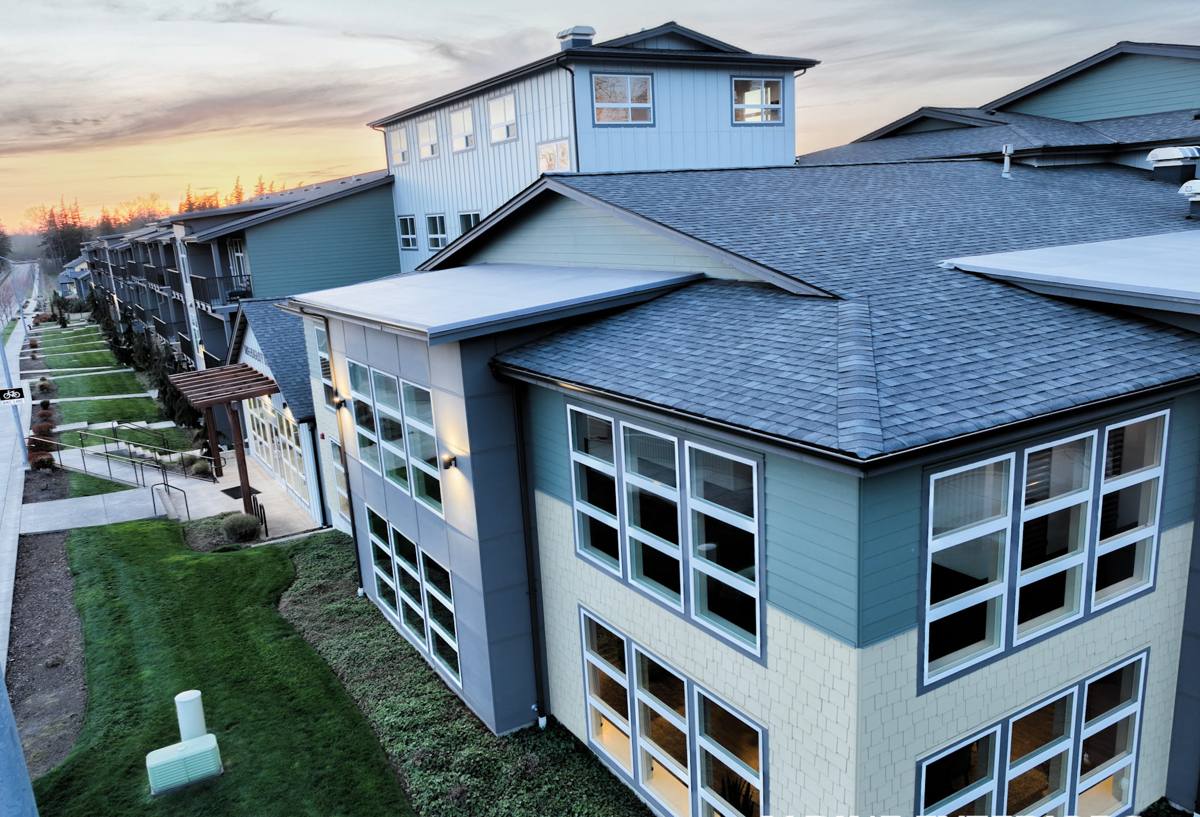
What a Long Moss Season Actually Does to a Wall
Moss doesn't just look bad. It holds moisture directly against the siding surface, slows drying after every rain event, and — on wood-based products — creates a steady low-grade moisture load that eventually reaches the substrate. On siding with any organic wood content, that sustained dampness is how rot starts: not from one big soak, but from months of a wall that never fully dries between storms. Around Lake Whatcom, with its shaded lots and long wet stretches, that cycle runs longer each year than it does in a more open, sun-exposed part of the county.
This is the core reason we don't install wood-based siding products on Sudden Valley homes, no matter how good they look going up. A siding material's real test isn't the first year — it's how it behaves after the twentieth wet winter with moss creeping up from the ground and settling into every shaded corner of the house.
Why Fiber Cement Is the Right Category for This Site
Fiber cement is a mix of Portland cement, sand, and cellulose fiber, cured into a rigid, dimensionally stable board. It has no wood grain to absorb water, doesn't swell or cup the way wood-based products can, and doesn't feed the fungal growth that moss and mildew need to spread. That makes it a fundamentally better match for a shaded, lake-adjacent lot than any wood-fiber or laminated wood-strand product. It's also non-combustible, which matters in a wooded, wildland-adjacent community where wildfire risk is a real consideration for insurance and for peace of mind.
We install James Hardie fiber cement exclusively — not LP SmartSide, not vinyl, not Cemplank or Allura, not primed spruce or cedar. That's a deliberate standard, not a sales pitch. Each of those alternatives has a real place in the market, but each also carries a trade-off — moisture sensitivity, appearance limits, warranty structure, or long-term maintenance burden — that we're not willing to put in front of a Sudden Valley homeowner and call a good long-term investment.
HZ5: The Climate-Engineered Detail That Matters Here
James Hardie makes region-specific formulations under its HZ (HardieZone) system, and HZ5 is engineered for cold, wet climates like the Pacific Northwest. The difference from a generic national product is in the formulation's moisture and freeze-thaw performance — relevant on a lake property where humidity sits high for long stretches and winter temperatures dip enough to matter. Specifying the correct zone product isn't a marketing detail; it's part of doing the job right for this specific address.
Material Comparison for a Lake Whatcom Property
| Factor | James Hardie Fiber Cement (HZ5) | Vinyl | LP SmartSide | Cedar |
|---|---|---|---|---|
| Moisture/moss resistance | Excellent — no wood content to rot | Good surface resistance, but seams and gaps trap moisture | Moderate — engineered wood strand still absorbs water at cut edges and damage points | Poor to moderate — requires ongoing sealing and moss treatment |
| Fire rating | Non-combustible | Combustible, can deform in heat | Combustible | Combustible |
| Expected service life (installed to spec) | 30+ years | 20-30 years, prone to cracking/fading | 20-30 years if maintained | 15-25 years with regular upkeep |
| Ongoing maintenance | Repaint cycle only (ColorPlus extends this significantly) | Low, but cannot be effectively repainted | Moderate — caulk and paint maintenance is not optional | High — sealing, staining, moss removal |
| Typical warranty structure | Long, transferable manufacturer warranty | Varies widely by product tier | Manufacturer warranty with maintenance requirements | Limited or none beyond installer workmanship |
What a Correct Installation Involves
Fiber cement performs the way it's supposed to only when it's installed to spec. The material itself is excellent; a rushed or shortcut installation is where problems start, and it's the single biggest variable in how a siding job holds up on a damp lot like this one.
- Removing existing siding and inspecting the sheathing and framing underneath for any moisture damage before anything new goes on — critical on a shaded property where hidden dampness is more likely.
- Installing a code-compliant water-resistive barrier and correctly lapped flashing at every window, door, and penetration, so water is directed out and down rather than behind the new siding.
- Maintaining the manufacturer-specified gap between the siding's bottom edge and the ground, roofline, decks, and any hardscaping — a detail that's easy to skip and directly affects how the material sheds water.
- Fastening according to Hardie's published pattern and fastener spec — nailing this wrong is one of the most common causes of failure, including buckling and premature paint issues.
- Proper joint treatment and caulking at butt joints and trim intersections, since these are the spots most exposed to driving rain and where a shortcut install shows up first.
- Choosing ColorPlus factory-applied finish where the color and budget allow, since it's baked on under controlled conditions and holds up far longer than field-applied paint in a wet climate.
Our Process for Sudden Valley Jobs
We start with an on-site walkthrough that looks specifically at how your lot handles water and shade — which walls stay damp longest, where moss has already established itself, and whether gutters and grading are pushing water toward the foundation. That assessment shapes the flashing and drainage plan before a single board goes up.
From there we handle removal, any necessary sheathing repair, the full weather barrier and flashing package, and the Hardie installation itself, followed by a final walkthrough with the homeowner. Because Sudden Valley is a lake community with private roads and, on many properties, an HOA with its own guidelines for contractor access and exterior project approval, we build that coordination into the schedule up front rather than discovering it mid-project. Working this neighborhood regularly means we already know how to plan around it.
Signs Your Current Siding Is Losing the Fight
- Green or black staining that returns within weeks of being cleaned, especially on shaded or north-facing walls.
- Soft spots, visible swelling, or a spongy feel when you press on the siding near the bottom courses.
- Paint that's peeling or bubbling in patches rather than fading evenly across the whole wall.
- Visible gaps opening at seams, corners, or trim where caulking has failed.
- A musty smell or visible staining on interior walls that back up to exterior siding.
- Warping or cupping boards that no longer sit flat against the wall.
Any one of these on its own isn't necessarily an emergency, but on a shaded lake lot they tend to compound quickly once moisture gets a foothold. Catching them early is usually the difference between a siding replacement and a much more expensive repair to the sheathing and framing behind it.
Warranty and What It's Actually Worth
James Hardie backs its siding with a long, transferable non-prorated limited warranty, and ColorPlus finishes carry their own finish warranty on top of that. That transferability matters on a lake property like this — it's a real selling point if you ever list the home, and it only holds up if the installation itself was documented and done to spec. That's part of why we treat the installation process itself as part of what we're delivering, not just the material.
Cost Factors for a Lake Whatcom Home
| Factor | Why It Moves the Price |
|---|---|
| Existing siding removal and disposal | Tear-off complexity and any hidden moisture damage found underneath |
| Access and site conditions | Steep or tree-covered lots, limited staging space, and private-road logistics common around the lake |
| Product line and finish | HZ5 lap, panel, or shingle profiles, and ColorPlus versus field-applied paint |
| Trim and detail work | Window and door casing, corner boards, and fascia treatments |
| Repair to sheathing or framing | Only known once old siding is removed and the wall is inspected |
Every property is different, and the only honest way to price a job is to see the walls in person. We give straightforward, written estimates after that walkthrough rather than a number pulled from square footage alone.
Why It Matters That We Already Work This Neighborhood
A crew that only shows up in Sudden Valley once knows the general rules of fiber cement installation but not the specific behavior of this lake environment — where moisture collects, which exposures take the worst of the driving rain, how long a wall stays wet after a storm rolls through. A crew that works here regularly brings that knowledge to every estimate and every install, and that shows up in fewer surprises once the old siding comes off.
If you're weighing a siding replacement on a Sudden Valley or Lake Whatcom property, we're happy to walk the house with you, point out what we see, and give you a straightforward, no-pressure estimate for a correctly installed James Hardie system. There's a form below — reach out and we'll set up a time to take a look.