 Sudden Valley Siding
 Siding Replacement in Geneva: Built for This Specific Corner of Whatcom County
Geneva sits along the north shore of Lake Whatcom, tucked into tree cover and hillside terrain that shapes how weather actually reaches a house here. It's a different exposure than open, flat neighborhoods a few miles away. Homes back up to timber, sit in partial shade for much of the day, and take on moisture that lingers rather than blowing through. Add in the driving rain that comes off Whatcom County's marine-influenced weather pattern and the salt-tinged air drifting in from nearby Bellingham Bay and Puget Sound, and you get siding conditions that punish shortcuts. When we replace siding on a Geneva home, we're not applying a generic Pacific Northwest playbook — we're accounting for shade, slope, tree cover, and moisture that doesn't evaporate quickly.
That combination is exactly why siding choice and installation quality matter more here than in drier, sunnier parts of the state. A product or install that would hold up fine in eastern Washington can fail early on a shaded, moisture-heavy lot near the lake.
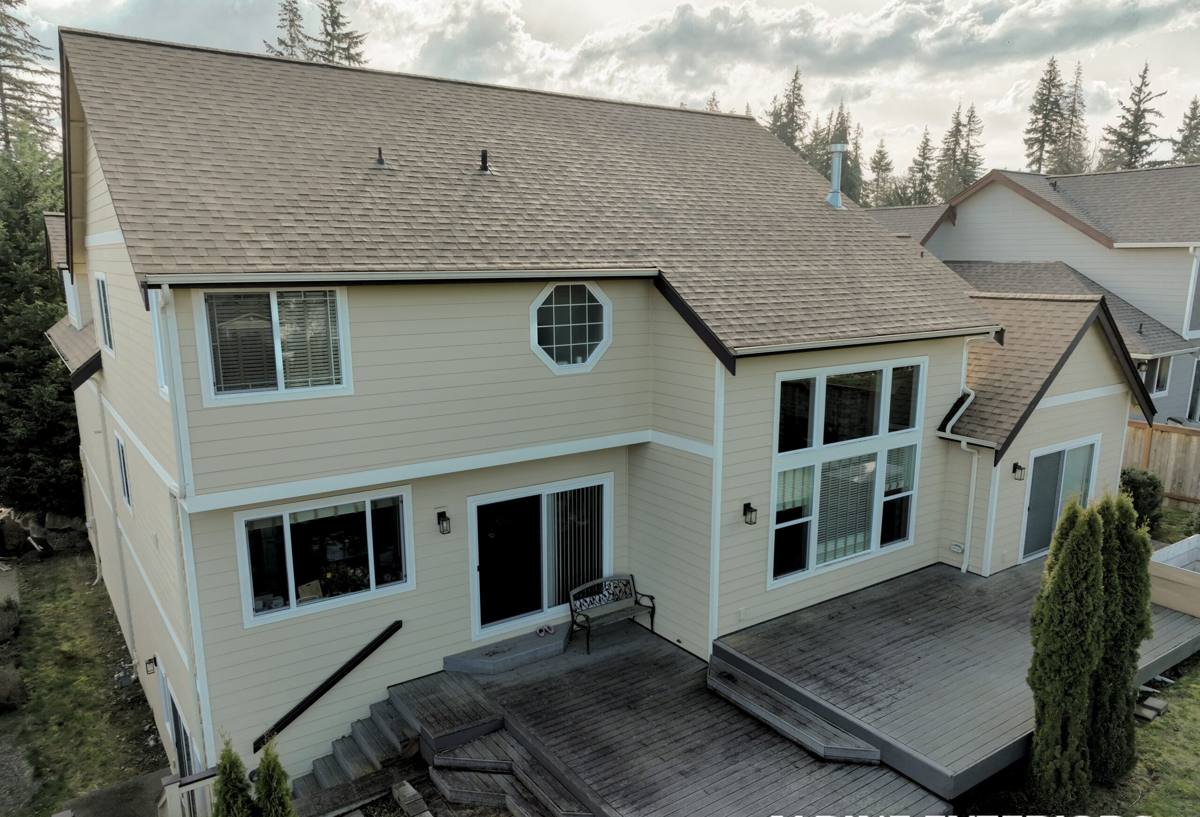
What Geneva's Climate Actually Does to Siding
Moisture That Doesn't Dry Out
Tree-covered, north-shore lots stay damp longer after rain than open lots. Siding, trim, and the wall assembly behind them need to shed water fast and dry out between storms. Materials or installations that trap moisture — bad flashing, no rainscreen gap, caulk used where a proper joint detail should be — turn a small amount of daily dampness into rot, delamination, or paint failure over a few seasons.
Driving Rain and Wind-Driven Exposure
Storms off the Sound don't always fall straight down. Wind-driven rain gets pushed sideways into wall assemblies, especially at inside corners, window and door trim, and anywhere siding meets a roofline or deck. This is where most siding failures actually start — not on the open field of a wall, but at the transitions and penetrations.
Moss and Organic Growth
Shaded, damp surfaces in this part of Whatcom County support moss and algae growth for a large part of the year. Moss holds moisture against a wall surface, and on materials that aren't built to resist that kind of sustained contact, it accelerates decay and finish breakdown.
Salt Air Influence
Even away from the immediate waterfront, proximity to Puget Sound means a low but steady level of airborne salt. Over years, that contributes to corrosion of fasteners, trim metal, and lower-grade finishes that aren't engineered for a marine-influenced environment.
Signs a Geneva Home Needs Siding Replacement, Not Just Repair
Not every siding problem calls for a full tear-off. But in this climate, small issues escalate faster than homeowners expect. Watch for:
- Soft or spongy spots when you press on siding, especially near the bottom courses and around window trim
- Paint or finish that's peeling, bubbling, or won't hold a fresh coat
- Visible gaps, warping, or buckling in panels or lap siding
- Persistent moss or dark staining that returns quickly after cleaning
- Siding that feels damp to the touch days after the last rain
- Rot or discoloration at corners, seams, and anywhere trim meets siding
- Rising energy bills that suggest the wall assembly behind the siding is compromised
One or two of these can often be repaired locally. Several at once — or any sign of moisture behind the siding itself — usually means the underlying material or installation has failed and replacement is the honest recommendation.
What a Correct Siding Replacement Job Actually Involves
Pulling old siding off and nailing up new panels is the easy part. The work that determines whether a Geneva home stays dry for the next 30-plus years happens underneath and around it:
Sheathing and Water-Resistive Barrier
Once old siding is removed, we inspect the sheathing for rot or soft spots before anything new goes up — no point installing premium siding over a compromised wall. A code-compliant water-resistive barrier goes on next, lapped correctly so water always sheds downward and outward.
Flashing at Every Transition
Windows, doors, decks, roof-to-wall intersections, and any penetration through the siding need proper flashing, not caulk as a substitute. This is the single most common place installations fail in wind-driven rain, and it's where a rushed crew cuts corners.
Rainscreen Gap
A small air gap between the water-resistive barrier and the siding lets any moisture that does get past the surface drain and dry out, instead of sitting against the wall. On shaded, moisture-prone lots like much of Geneva, this detail matters more than it does on a dry, sun-exposed site.
Fastening and Fit
Fiber cement siding has specific fastening requirements — correct nail type, placement, and spacing — that differ from wood or vinyl. Installed wrong, it can crack, blow off in wind, or fail to seal properly at seams.
Why We Install Only James Hardie Fiber Cement
We standardized on James Hardie siding for every job we do, including here in Geneva, because it's built for exactly the conditions this area produces. Hardie's fiber cement is non-combustible, resists moisture-driven rot and swelling far better than wood-based products, and holds its shape against the freeze-thaw and wet-dry cycling common in this climate. The ColorPlus factory finish is baked on under controlled conditions rather than field-painted, which matters directly for moss and mildew resistance and for holding color in a shaded, damp environment where field-applied paint tends to fail early.
Hardie's HZ5 product line in particular is engineered for climates with significant moisture exposure — which describes the Lake Whatcom basin well. Combined with a transferable warranty and a track record of long service life when installed to manufacturer spec, it's the product we're willing to put our name behind. We don't install vinyl, LP SmartSide, primed wood, or comparable fiber cement alternatives — not because those products have no legitimate use, but because we've made a professional call about what performs best, longest, in this specific climate, and we'd rather do one thing well than offer options we wouldn't choose for our own home.
How Common Siding Materials Compare in This Climate
| Material | Moisture Resistance | Moss/Algae Resistance | Finish Durability | Typical Lifespan Here |
|---|---|---|---|---|
| James Hardie fiber cement | High — won't rot or swell | Good with factory finish | Factory-baked ColorPlus, long-lasting | 30+ years |
| Vinyl siding | Sheds water but can trap moisture behind it | Moderate; surface growth common in shade | Fades and becomes brittle over time | 15–25 years |
| Primed wood/spruce | Low — prone to swelling and rot without diligent upkeep | Poor in shaded, damp conditions | Needs repainting every 3–7 years | 10–20 years, upkeep-dependent |
| Engineered wood (e.g., LP SmartSide) | Moderate — treated but still wood-based | Moderate; edge sealing critical | Field or factory finish, moderate durability | 20–30 years, spec-dependent |
Our Siding Replacement Process
The process is the same discipline whether the job is a small rambler or a larger home on a wooded Geneva lot:
- On-site assessment — we look at existing siding, trim, moisture history, sun/shade exposure, and any visible rot or damage before quoting anything.
- Written estimate — scope, product line, color, and price, with no pressure to sign on the spot.
- Tear-off and inspection — old siding comes off, sheathing is checked, and any rot or damage is addressed before new material goes on.
- Water-resistive barrier and flashing — installed and detailed at every window, door, and transition point.
- Hardie installation — fastened, fitted, and finished to manufacturer specification, including rainscreen where the wall assembly calls for it.
- Final walkthrough — we go over the finished job with the homeowner before we consider it done.
Why a Crew That Already Works in Geneva and Sudden Valley Matters
A crew that regularly works this side of Lake Whatcom already knows how shaded, tree-lined lots behave — where moss builds up fastest, which wall orientations take the worst of the driving rain, and how access and staging work on hillside and lakeside lots that aren't always flat, easy driveways. That familiarity shows up in small decisions during a job: where to add extra flashing attention, which details need reinforcing against wind-driven rain, and how to sequence work around Whatcom County's wetter stretches of the year. It also means we're not learning the neighborhood on the homeowner's dime.
Maintaining Your New Siding
Hardie fiber cement is low-maintenance compared to wood, but "low-maintenance" isn't "no-maintenance," especially in a shaded, moisture-heavy setting like Geneva. A simple annual routine keeps it performing as designed:
- Rinse siding gently once or twice a year to clear pollen, moss spores, and organic buildup before it takes hold
- Keep gutters clear so overflow doesn't run down siding surfaces
- Trim back branches and vegetation that keep siding in constant shade and dampness
- Check caulking at trim and penetrations annually and re-seal if it's cracked or pulling away
- Address any impact damage or chipped finish promptly rather than letting moisture get behind it
Cost Factors for Geneva Siding Replacement
Every home is different, but the biggest cost drivers on a Geneva siding replacement tend to be the same handful of variables:
| Factor | Why It Matters |
|---|---|
| Home size and wall complexity | More corners, gables, and trim detail mean more material and labor |
| Condition of existing sheathing | Rot found during tear-off adds repair scope before new siding can go on |
| Access and site terrain | Hillside and wooded lots can require more staging and care |
| Siding profile and color | Lap width, panel style, and ColorPlus color selection affect material cost |
| Trim and detail work | Window/door trim, corner boards, and fascia detail add labor time |
Full siding replacement projects in this area typically run in the low-to-mid five figures for an average home, scaling up with size and complexity. We won't give a real number without seeing the house — anything else is a guess.
If your Geneva or Sudden Valley home is showing signs of siding wear, or you're planning ahead before the next wet season sets in, we're glad to take a look. The estimate is free, there's no pressure, and you'll get a straight answer about what your home actually needs.