 Sudden Valley Siding
 Why Decks in Edgemoor Wear Out Faster Than the Warranty Suggests
Most deck problems in this part of Whatcom County don't start with the boards you can see. They start underneath, where moisture sits against untreated cuts, hardware corrodes quietly, and framing loses its structural margin long before the surface looks bad. Edgemoor's proximity to the water means homes here deal with salt-laden air on top of the standard Pacific Northwest problem of near-constant dampness for much of the year. That combination is harder on a deck than either factor alone.
Salt air accelerates corrosion in fasteners, joist hangers, and any exposed metal connector. Driving rain finds its way into every joint, seam, and screw hole that wasn't properly sealed at install. And the long moss season here — often stretching from fall through spring — keeps deck surfaces damp for extended stretches, which feeds rot in wood decking and can make even composite boards dangerously slick. A deck built or repaired without this climate specifically in mind tends to look fine for a few years, then fail all at once.
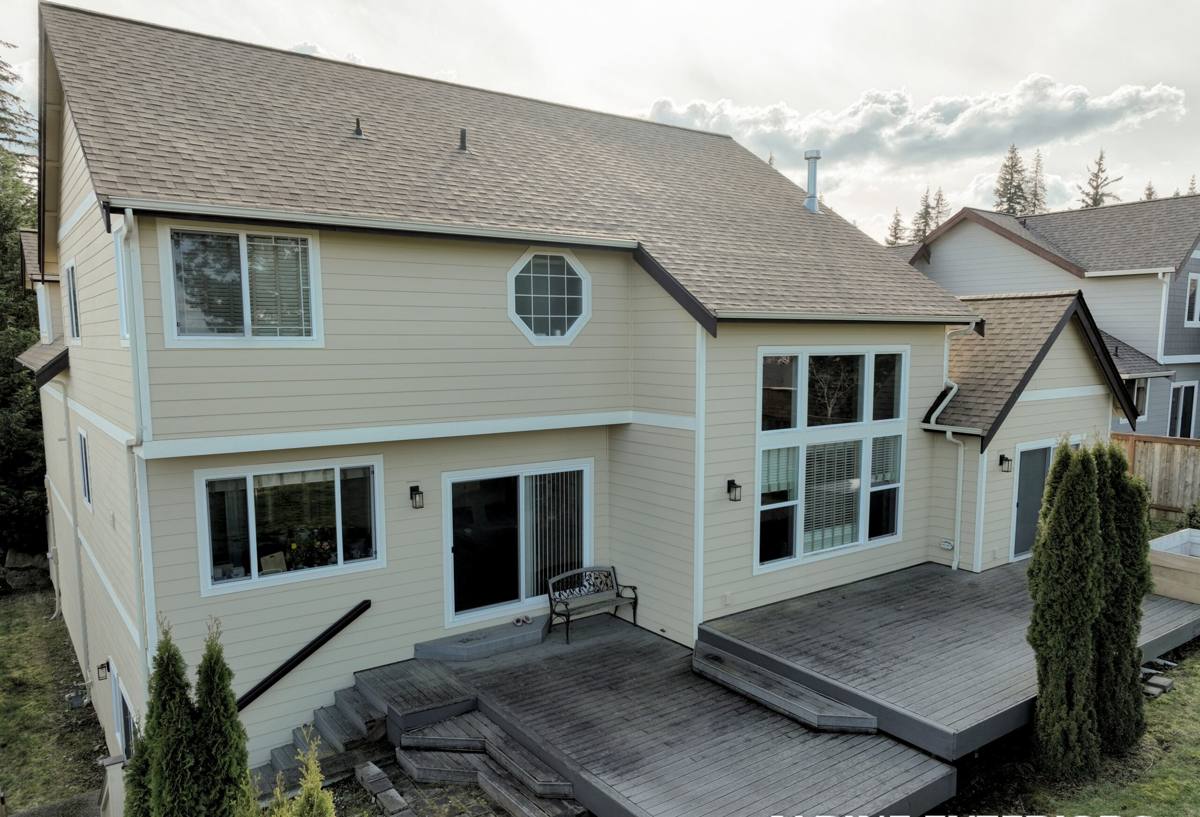
What "Deck Replacement" Should Actually Mean
A lot of what gets sold as deck replacement is really just a board swap — pull off the visible decking, screw down new boards, call it done. That approach ignores the parts of the deck that actually determine how long it lasts. A proper replacement addresses the whole system:
- The ledger board connection to the house, including flashing
- The condition and layout of the joists and beams underneath
- Post footings and their depth, especially on sloped or wooded lots
- All structural hardware — hangers, bolts, screws
- Drainage and airflow underneath the deck
- The decking surface, railing, and stair material itself
If a contractor is only quoting the last item on that list, you're not getting a replacement — you're getting a resurfacing, and it will show its age fast in this climate.
The Ledger Board and Flashing: Where Most Failures Actually Start
The ledger board is the piece that attaches your deck to the house, and it's the single most common point of structural failure in this region. When it's flashed correctly, water sheds away from the house and off the top of the ledger. When it's flashed poorly — or not flashed at all, which was common practice on older builds — water tracks behind the siding and sits against the rim joist and ledger for months at a time.
In a wetter climate like ours, that hidden rot can go undetected for years because the deck surface itself gives no warning signs. By the time you notice sponginess, movement, or a gap opening up between the deck and the house, the framing behind it may already be compromised. Any legitimate deck replacement includes pulling the ledger, inspecting the rim joist and sheathing behind it, and installing proper flashing — a self-adhering membrane under a metal drip cap, lapped correctly with the house's water-resistive barrier — before a single deck board goes back on.
Signs Your Ledger Connection May Already Be Failing
- A visible gap or shadow line where the deck meets the house
- Discoloration or staining on the siding directly above the ledger
- Any bounce or give when you walk near the house-side edge of the deck
- Soft spots in siding or trim near the connection point
Choosing Decking Material for This Climate
There's no single "best" decking material — there's a best fit for your budget, how the deck is used, and how much maintenance you're willing to keep up with. In an area with heavy rain and a long moss season, moisture behavior and slip resistance matter as much as looks.
| Material | Moisture Behavior Here | Maintenance | Typical Lifespan |
|---|---|---|---|
| Pressure-treated wood | Absorbs moisture readily; needs sealing to resist moss/algae staining | Annual cleaning and re-sealing recommended | 10–15 years with upkeep |
| Cedar | Naturally rot-resistant but still needs finish maintenance in wet climates | Periodic cleaning, re-staining every few years | 15–20 years with upkeep |
| Capped composite | Doesn't rot, but can develop mold/algae film if not cleaned | Periodic washing; no sealing or staining | 25+ years |
| PVC decking | Fully moisture-resistant, best option for constant dampness | Occasional washing | 25–30+ years |
We don't push one product over another as a blanket rule — we walk through the trade-offs with you. Wood costs less up front but demands a real annual maintenance commitment in this climate or it will show moss and gray streaking within a season or two. Composite and PVC cost more initially but hold up with far less intervention, which matters if the deck sits under tree cover or gets limited direct sun to dry out between rains.
Substructure and Hardware: Where Salt Air Does the Damage
Being close to the water is good for a view and hard on metal. Standard galvanized fasteners and connectors can corrode faster here than they would further inland, and once a joist hanger or bolt weakens, it's compromising the deck's structural capacity even if nothing looks wrong from the top. On any replacement, we spec stainless steel or high-grade coated fasteners rated for coastal exposure, and we check that joist hangers, post bases, and structural screws all match — mixing incompatible metals speeds up corrosion through galvanic reaction.
Post footings get the same scrutiny. Whatcom County's soil and drainage vary a lot lot by lot, and on sloped or heavily treed properties, footings that were adequate decades ago sometimes don't meet current code depth or bearing requirements. We check this during the assessment rather than assuming the old footings are fine to build on.
Moss, Algae, and Drainage: Designing the Deck to Actually Dry Out
A deck that never gets a chance to dry between rains is a deck that grows moss, holds moisture against the framing, and becomes slippery underfoot. Two design decisions make the biggest difference:
Board Spacing and Airflow
Proper gapping between boards, and clearance underneath the deck for air to move, lets both the top and bottom surfaces dry out. Decks built tight to grade with no ventilation underneath stay damp for days after a storm, which is exactly the condition moss and algae need to establish.
Surface Drainage
Where the deck meets the house, and at any low points in the frame, water needs a clear path off the structure rather than pooling. On replacements we address slope and drainage as part of the framing work, not as an afterthought once decking is already down.
Our Process for Edgemoor Deck Replacements
- On-site assessment — we inspect the ledger connection, framing, footings, and hardware, not just the visible decking, and tell you honestly what's structural versus cosmetic.
- Written scope and estimate — a clear breakdown of what's being replaced, what materials are involved, and why, before any work starts.
- Permitting — deck replacement often requires a permit depending on scope and size; we handle that so you're not caught off guard later.
- Demolition and structural rebuild — old decking, and any compromised framing or ledger flashing, comes out and gets rebuilt to code.
- Decking, railing, and finish work — installed with fastener spacing and hardware suited to a coastal, high-moisture climate.
- Final walkthrough — we go over the finished deck with you, including what maintenance it needs going forward.
Why a Crew That Already Works in Edgemoor Matters
Deck failures in this area follow patterns we've seen repeatedly: ledger flashing done wrong or skipped, fasteners that weren't rated for salt exposure, footings undersized for the actual soil conditions, and decking chosen without accounting for how much shade and moss pressure a given lot gets. A crew that regularly works homes in Edgemoor and the surrounding Sudden Valley area isn't learning these lessons on your project — they've already accounted for them before the first board comes off.
That local familiarity also means a more accurate first assessment. We know what to check for on a coastal Whatcom County deck that a crew unfamiliar with this specific climate might not think to look for, which saves you from surprises mid-project.
Keeping a New Deck Healthy After Replacement
- Sweep debris and standing leaves off the deck regularly, especially heading into fall and winter
- Clean moss or algae film as soon as it appears rather than letting it establish
- Check the ledger flashing area annually for any staining or gaps
- Keep gutters and downspouts near the deck clear so runoff isn't dumping onto it
- Re-seal wood decking on the manufacturer's recommended schedule, not just when it looks dry
- Confirm underneath ventilation stays clear of stored items or overgrown landscaping
If your deck is showing its age — or you just want an honest read on whether it needs full replacement or targeted repair — we're happy to take a look. Fill out the form below for a free, no-pressure estimate.